

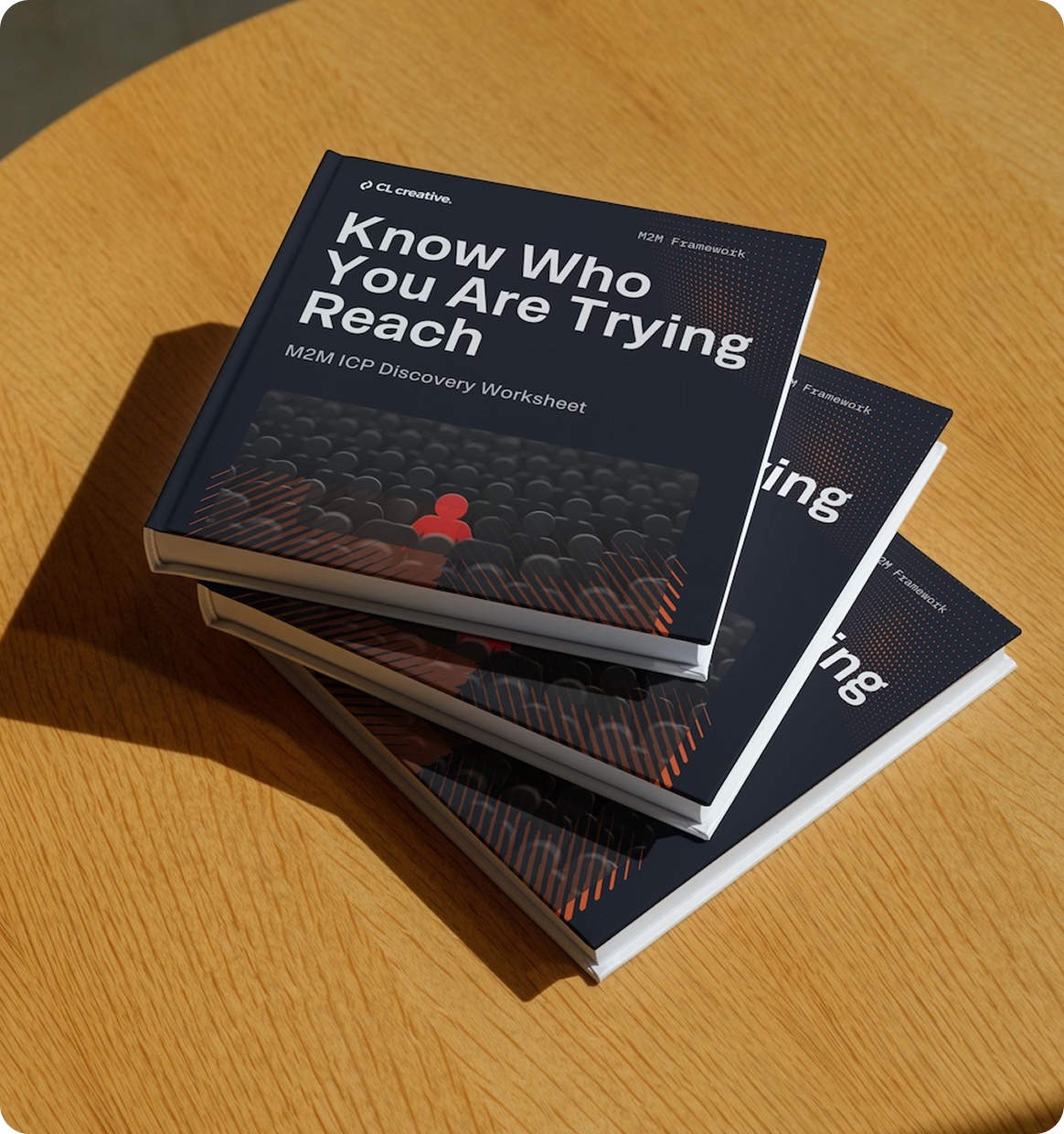
Get the M2M ICP Discovery Worksheet
Know who your website should speak to and what to say.
You've been researching Webflow agencies for a week and every one of their homepages reads exactly the same. Strategy-led. Conversion-focused. Award-winning. A grid of logos, a carousel of testimonials, and a "Book a call" button that tells you nothing about pricing, process, or whether they're actually any good.
I get it. I run one of these agencies, and I read my competitors' homepages too. Sometimes they sound interchangeable.
That's why knowing how to choose a Webflow agency feels like a coin flip. This guide is what I wish existed if I was on the other side of that decision.
It lays out:
- The criteria that actually matter
- The questions most business owners don't know to ask
- And honest advice on when a small studio like mine is the right call versus when you should pay more for a bigger team.
No gatekeeping, no fake scarcity, no "schedule a call to learn more."
Figure out what the agency is actually selling
Here's the thing most people miss. Webflow agencies are not one product.
They're three, and the one you need depends on what you already have figured out about your business.
(1) Production studios sell execution.
You bring the strategy, the copy, and the direction. They build a polished Webflow site. Great if you already know what your website should say. Not great if you don't.
(2) Design-led agencies sell visual craft.
The output is a beautiful, award-worthy site. If you're in a brand-driven space like fashion, hospitality, or creative services, and the look has to carry the business, this is the right kind of partner. If you're a B2B service company trying to generate leads, beautiful alone won't get you there .

(3) Strategy-led agencies sell the business outcome.
They do real research on your ideal customer, shape the messaging, structure the site around how people actually buy, and use Webflow as the delivery mechanism. Costs more. Takes longer. It's the only version of the three that's designed to convert, not just impress .

None of these is better in the abstract. They're different products sold at similar prices. The mistake is assuming they're the same thing.
If you don't know which one you need, ask yourself this.
Can I explain, in one sentence, who my ideal customer is and what they care about?
- If yes, production or design-led might be fine.
- If no, you need strategy first.
Everything else is window dressing on a house with no foundation.
The one question that filters 80% of agencies
Can the agency tell you, after a 30-minute discovery call, who your ideal customer is?
If yes, they're doing strategy. If no, they're doing design. That's the whole test.
I talk to prospects every week who've had three calls with three agencies, and not one of those agencies asked a real question about the prospect's business. They all pitched their process. They all talked about their previous work. None of them got curious about the person on the other end of the call.
The M2M Framework I use with clients at CL Creative (Market to Message) is built on one belief. You cannot write a homepage, structure a sitemap, or design a CTA without first understanding the person you're trying to reach .

If an agency skips that step, they're building the same website for every client with a different coat of paint. That's not what you're paying for, even if it's what you're getting.
The evaluation checklist
Use this before you sign anything. If an agency can't answer most of these clearly, that's your answer.
- Can they tell you, in one sentence, who your ideal customer is after the discovery call? If not, they're not doing strategy. They're doing design.
- Is the pricing transparent, or do you have to book three calls to get a number? Agencies that hide pricing are usually hiding something else too.
- Who actually does the work? Ask by name. Is it the founder you're talking to now, or a junior contractor you'll never meet?
- How many projects do they take at a time? A studio juggling twelve concurrent builds isn't giving any one of them full attention.
- What does the process look like, week by week? Vague answers like "we collaborate closely" are a red flag. You want specifics.
- Who owns the copy? If copywriting isn't explicitly part of the scope, you're writing it yourself.
- What happens after launch? Thirty days of support? Ongoing retainer? Nothing? Know before you sign.
- Can they show you the Webflow backend of a recent project? A clean, well-organized Webflow project means a team that will leave you with a site you can maintain. A messy one is technical debt you'll inherit.
- Do they have opinions? Agencies without opinions build whatever you ask for. That's fine if you know exactly what you want. If you don't, you need a partner who'll push back.
Ten questions to ask on every discovery call
Copy these, paste them into your notes, and ask every agency the same set. Consistency is how you actually compare.
- Who is your ideal client, and am I one of them? A good agency will tell you honestly if you're not a fit. A bad one takes any project with a pulse.
- What's included in your base engagement, and what's extra? Get it in writing. "A website" is not a scope.
- How do you approach messaging and copy? If the answer is "we'll work with what you give us," budget for a copywriter separately.
- What does your discovery process look like? You want to hear about ICP research, customer interviews, a messaging workshop, or something concrete.
- Can I see a recent project from the Webflow dashboard side? Clean CMS collections, properly named classes, and organized pages matter for the next three years of your life.
- What's your average project timeline, and what causes it to slip? Every agency has slip risk. The honest ones name it.
- How do revisions work? How many rounds? How are they scoped? What happens if you need a third or fourth?
- What's your post-launch support model? Free support window? Retainer? Hourly?
- Will I own everything when we're done? Fonts, imagery, copy, the Webflow project itself. Ownership of your own site should not be a negotiation.
- If this project went sideways, what would it most likely look like? Gut-check question. Agencies that have never seen a project go wrong are either new or lying.
What a Webflow site actually costs
A real Webflow site from an agency runs $5,000 to $25,000 and up.
If an agency quotes you $2,000 for a "full website," assume templated design, stock copy, and no ongoing relationship. That's fine for a side project. It's not fine for the site that represents your business.
Want the full breakdown of what drives a quote up or down? Read our Webflow pricing guide for the whole picture.

Red flags
These are the signs a Webflow agency isn't going to deliver what you think you're buying.
- They can't articulate your ICP back to you. Strategy without an ICP is just taste.
- Their portfolio looks identical across every client. That's a template shop with a branding coat of paint.
- They won't share references. Every solid agency has two or three past clients who'll talk to a prospect.
- The quote is 80% lower than everyone else's. Someone is cutting corners. It's either design time, strategy, copy, or post-launch support.
- The contract is vague about deliverables and timelines. "A custom website" is not a deliverable. "A 10-page Webflow site with three CMS collections, integrated HubSpot forms, and on-page SEO for five primary keywords, delivered in eight weeks" is.
- They pressure you to sign fast. Good agencies have pipeline. They can wait a week.
- No one on the call can answer technical questions. If the salesperson keeps saying "I'll check with the team," you're talking to a broker, not a builder.
- They sell you on their process before understanding your business. You should spend most of the discovery call talking about you, not listening to a pitch deck.
Honest comparisons: who does what well in 2026
This is the part most guides skip. A few Webflow studios come up again and again when prospects are shopping, and each is a different shape of partner. Here's honest guidance on when each is the right call, even when it's not us.
Large Webflow agencies (Veza Digital, Flow Ninja, SVZ, Refokus)
Best for: Funded startups, mid-market companies, and enterprise teams with a dedicated marketing lead, a six-figure project budget, and complex requirements (multi-language sites, heavy integrations, custom Webflow app development).
Trade-offs: You're one of many concurrent projects. Day-to-day work is usually handled by a rotating team of contractors or junior designers, not the senior folks you met in the sales process. Timelines are longer. Floor price is usually north of $25,000.
Pick them when: Your project is complex enough that you need a deep bench, you have internal resources to manage the agency, and budget isn't the constraint.
Boutique studios (CL Creative and similar)
Best for: Small and growth-stage businesses doing $500K to $5M in revenue who want a strategy-first partner, want to work directly with the founder or senior strategist, and need a site that doubles as a revenue tool.
Trade-offs: Smaller bench means we take fewer clients at a time. If you need a mobile app and a web build all at once, a larger agency is a better fit.
Pick us when: You want a site built around your actual customer, not a generic template.
You value directness, transparency, and a partner who'll tell you no.
You'd rather have three to five clients per quarter getting full attention than be project number eleven at a larger shop.
If you want the long version of who we work best with, we wrote a whole post on whether CL Creative is a fit for you .

Freelancers and solo Webflow developers
Best for: Simple marketing sites, budgets under $5,000, clear scope, and a founder comfortable directing the project themselves.
Trade-offs: Strategy and copy are usually on you.
Pick them when: You have a tight budget, a clear vision, and the bandwidth to manage the work yourself.
Marketplace platforms (Clutch, Upwork, Webflow Experts directory)
Best for: Sourcing options when you don't know where to start. Use these to build a shortlist, not to make a final decision.
Trade-offs: Reviews are easy to game and agency quality varies wildly. Treat marketplace listings as leads, not verdicts.
How to run your shortlist
A process that works:
- Start with four or five agencies. More than that and you'll burn out comparing.
- Screen out the ones whose website doesn't answer your questions. If they can't give you an idea of what they do and who they do it for, as well as provide you with some examples of their work, then cut them from the list. If they aren't clear on their business and who they work best with, how can they help you answer those questions for your business?
- Book discovery calls with the remaining two or three. Use the ten questions above. Take notes.
Then pick the one who asked the best questions about your business. Not the one with the slickest pitch.
What it comes down to
There are a lot of good Webflow agencies. There are also a lot that'll happily take $15,000 and give you a worse version of what you already have.
The difference is almost never the design quality on the homepage. It's the discovery process, the questions they ask, the people who actually do the work, and whether they care about your business outcome or their portfolio.
If you want to see whether we're a fit, I offer a free strategy session where we walk through your current site, your market, and what a Webflow project would look like for your business. No templated sales deck, no pressure, just a real conversation.
Pricing and agency information current as of 2026. Things shift year to year, so check back or ask us directly if you want the latest picture.

Your Marketing Isn't Bringing in Leads and You Can't Figure Out Why
Score your marketing across 7 key areas in 5 minutes and find out exactly what's holding back your leads and what to fix first.
Questions You Might Be Asking
You're ready when your current site is actively losing you business or embarrassing you in sales conversations, you know the kind of customer you want more of, and your budget matches the tier of agency you're considering. If you're hiring an agency hoping they'll figure out your business for you, you're not ready. That's not what agencies do.
Portfolio matters, but not as much as you think. A gorgeous portfolio tells you they can design. It doesn't tell you they can make you money. Dig in and see if strategy leads their process or if they are just good at making websites look gorgeous.
If you want Webflow specifically, pick a Webflow-specialized studio.
Generalist agencies will often build you a Webflow site, but they're usually slower on the platform, less familiar with its CMS conventions, and more likely to leave you with technical debt that slows down every future edit.
A specialist will build it faster, cleaner, and in a way you can maintain.
Be honest with yourself about timing. Hiring an under-budget agency usually means an under-budget result, which means redoing the site in eighteen months and spending twice.
If the budget isn't there, consider a high-quality template build from a solo developer for the interim and plan the proper engagement for the following fiscal year.
Three things.
(1) Get everything in writing, including scope, revisions, timeline, and deliverables.
(2) Look at reviews from past clients before you sign.
(3) Watch how the agency handles your hardest question in the sales process. That's how they'll handle the hardest moment in the project.


