

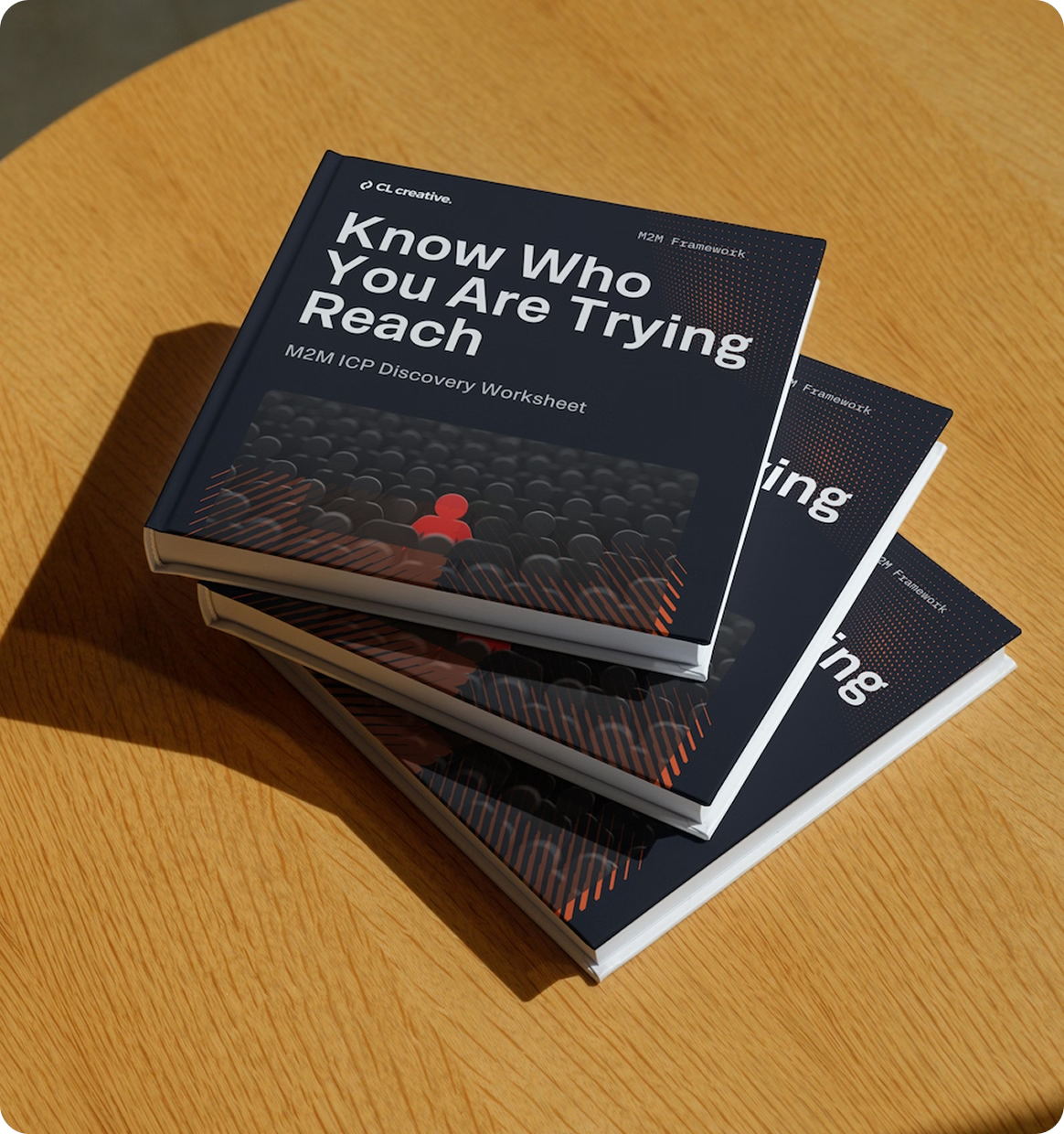
Get the M2M ICP Discovery Worksheet
Know who your website should speak to and what to say.
A Webflow website costs between $5,000 and $25,000 to build with an agency, depending on the complexity of the design, the amount of custom development, and whether the project includes copywriting and strategy. Most small service businesses doing $500K to $2M in revenue land in the $8,000 to $15,000 range for a full marketing site with a CMS, a few landing pages, and real messaging work behind it.
But the number most agencies quote you isn't the number you'll actually pay, and there's a reason almost nobody puts pricing on their website in the first place.
Here's why the number you see online is almost always wrong
Pricing is the first thing most business owners want to know and the last thing most agencies are willing to put on their website. That's frustrating when you're trying to budget, compare options, or decide whether hiring an agency even makes sense for your stage.
Part of the reason is that every project is different. Part of it is that agencies are afraid to scare you off before they get you on a call. Either way, the result is the same: you spend hours researching and still don't know what your site is going to cost.
So instead of dancing around it, here's the actual breakdown. These numbers come from the projects I run at CL Creative and the quotes I've seen clients bring me from other agencies.
What you get at $5,000 to $8,000
This is the starting point, and it's where a lot of growth-stage businesses land when they've outgrown a DIY site but aren't ready to treat their website as a full revenue engine yet. At this tier, you're getting:
- A custom Webflow site with 5 to 8 pages, designed around your brand (not a template)
- A real CMS setup for blog posts or services so you can update the site yourself
- The M2M questionnaire and a working session to ground the messaging in your actual customer before design starts
- On-page SEO built in from the start
- A standard contact form and the integrations you need to run your business
What you're not getting at this tier is the deeper strategic layer — the multiple landing pages, the conversion-focused funnels, the complex CMS architecture. You're getting a site that looks like you've got your act together and gives you a foundation to grow from.
This range works for businesses at the lower end of the $500K revenue mark, where referrals are still carrying most of the load, or for companies replacing an old WordPress site that's become a liability. The work is still custom. It's still strategy-first. It's just scoped tighter.
What you get at $8,000 to $15,000
This is where most of my clients land, and it's where a Webflow project starts to earn its keep. At this tier, you're getting everything from the lower tier, plus:
- Custom design with more unique page layouts and refined brand expression
- A real CMS setup with multiple collections (blog, case studies, services, team)
- A few targeted landing pages built around your main services or campaigns
- Professional copywriting tied to your ICP instead of generic platitudes
- A deeper M2M engagement — the same questionnaire, but with a full review session together to pressure-test your positioning and pull out the messaging angles that matter
- Custom interactions and scroll animations that support the message
- CRM or email marketing integrations
For a small service business that's ready to stop leaning on referrals, this is usually the sweet spot. You're spending enough to get something that actually converts, but you're not overpaying for features you don't need yet.
And with a website that is positioned to generate revenue for you, it should pay for itself in no time. A few closed deals in many instances cover the cost of the website.
If that's the range you're evaluating, let's talk.
I'm currently booking projects in the $8K–$15K sweet spot. Book a 45-minute strategy session and we'll look at your current site, your market, and what a Webflow project would actually look like for your business. You'll leave with a clearer picture of what your site needs to do and a rough budget range, whether you hire me or not.
What you get at $15,000 to $25,000
Above $15,000, you're buying strategy and custom functionality, not just a prettier site. Projects in this range usually include:
- A full messaging and positioning workshop before any design happens
- Custom interactions and animations
- Complex CMS architecture (multi-language, gated content, integrations with tools like HubSpot or Pipedrive)
- Professional copywriting for every page
- A project team that may include a dedicated copywriter, strategist, or specialist developer depending on scope
This tier makes sense when your site is a real revenue engine, not just a brochure. If you're spending money on ads, doing outbound sales, or competing in a crowded market where the right messaging actually moves the needle, this is the range where a Webflow site starts to pay off in a measurable way.
What drives the price up or down
Four things move your quote more than anything else:
- Page count. A 6-page site and a 25-page site are wildly different projects, even if the design language is the same.
- Custom design versus templated. Building around a clear brand from scratch is more work than adapting an existing template.
- Copywriting. Good copy is half the project. If an agency is doing ICP research and writing every page, expect to pay for that expertise separately.
- Integrations and functionality. A contact form is free. A custom booking system tied to your CRM, a members area, or a multi-step quote calculator is a real line item.
Ask upfront what's included and what's extra. The quote you sign on day one should match the invoice you get at the end.
Red flags when evaluating proposals
A few warning signs that suggest an agency might not be the right fit.
Prices that seem dramatically low
If you're getting quotes of $1,500 for a custom Webflow site, something's off. Either the scope isn't what you think, the designer is very junior, or you're getting a lightly customized template being sold as "custom."
You get what you pay for. Cheap websites often cost more in the long run when you have to redo them in 18 months. I work with a lot of growth-stage companies, and this is typically the case. They went the cheaper route just to get something up, but later have to redo the entire site because it wasn't built to scale.
Just because a site looks good doesn't mean the bones are there to build on. If you're going to grow, your website needs to scale with you. A site that sits static isn't going to help you reach the next level in your business.
Vague scope or no written proposal
A professional agency provides a detailed proposal outlining exactly what you're getting: number of pages, features included, revision rounds, timeline, and what's explicitly out of scope. If you're getting a verbal quote with no documentation, that's a recipe for misunderstandings later.
No portfolio of relevant work
Ask to see projects similar to yours — in scope, industry, or complexity. A beautiful portfolio of one-page splash sites doesn't tell you much if you need a 15-page site with complex CMS.
100% payment upfront
Standard practice is a deposit (typically 30-50%) with remaining payments tied to milestones. Requiring full payment before any work begins is unusual and risky for you.
No discussion of post-launch support
Your website will need updates after launch. If the agency hasn't mentioned what happens after handoff — bug fixes, training, ongoing support options — then you need to ask. Agencies that disappear after launch leave you stranded when something breaks.
No strategy behind the design
If the agency can't tell you who your ideal customer is after the discovery call, they're not doing strategy. They're just doing design. That's a real distinction, and it's usually the difference between a site that looks good and a site that actually brings in leads.
If the quote doesn't mention copywriting at all, ask. You either need to write it yourself (which most business owners hate doing) or the agency is assuming you'll hand them copy and they'll paste it in. Neither of those is wrong, but you need to know which one you're signing up for.
Common follow-up questions
How long does it take to build a Webflow site? Most small business projects take 4 to 8 weeks from kickoff to launch. Strategy and discovery usually take the first week or two, design and build take the middle stretch, and the last week is QA, content loading, and revisions.
Is Webflow cheaper than WordPress? Upfront, Webflow projects are usually similar or slightly more expensive than WordPress. Over time, Webflow is almost always cheaper because you're not paying a developer every time something breaks, and hosting is simpler.
Can I update a Webflow site myself after launch? Yes, and this is one of the biggest reasons small business owners pick Webflow in the first place. The CMS is built so non-technical users can add blog posts, update services, or swap out images without needing to call their developer.
What's included in ongoing Webflow hosting? Webflow hosting runs $14 to $39 a month depending on the plan, and it covers the CDN, SSL, site backups, and a staging environment. That's it. No separate plugins to manage, no security updates to install, no uptime monitoring to set up.
Ready to talk about what your site should cost?
Every business is different, and the only way to get a real number is to have a real conversation about your goals, your customer, and what the site actually needs to do.
I offer a 30-minute strategy session where we'll walk through your current site, your market, and what a Webflow project would look like for your business. You'll leave with a clearer picture of what your site needs to do, a rough budget range based on your goals, and concrete next steps, whether we end up working together or not.
No prep required. Bring your questions.
Book a free strategy session →
Not quite ready to book? Get the M2M Worksheet. It's the same customer-and-messaging framework I use on every project, so you can start sharpening your positioning before you hire anyone. Work through it on your own and you'll know exactly who your site should speak to and what it should say.

Your Marketing Isn't Bringing in Leads and You Can't Figure Out Why
Score your marketing across 7 key areas in 5 minutes and find out exactly what's holding back your leads and what to fix first.
Questions You Might Be Asking
It depends on the agency. Some bundle copywriting into the build, others scope it as a separate line item because the research and writing work is substantial on its own. Always ask upfront — if a quote doesn't mention copy, the agency is probably assuming you'll supply it. Plan for either your own time or a dedicated budget so it doesn't become a surprise at launch.
A 30–50% deposit is standard, with the remainder split across milestones like design approval, development completion, and launch. Paying 100% upfront is a red flag — it removes any incentive for the agency to stay on schedule. A milestone-based structure keeps both sides accountable and gives you leverage if something goes off track.
Yes. Even a well-built site needs occasional updates — new pages, design tweaks, integrations with new tools, or fixes when something breaks. Plan for either a retainer with your agency or a monthly support package. Webflow hosting itself runs $14–$39 per month, but that only covers the CDN and SSL, not development time.
Look at what the site has to do for you. If referrals are still driving most of your revenue and you just need a professional foundation, the lower tier fits. If you're running ads, doing outbound, or competing in a crowded market where messaging actually moves the needle, the mid-tier pays for itself faster. A free strategy call is the fastest way to figure out which side you're on.


