
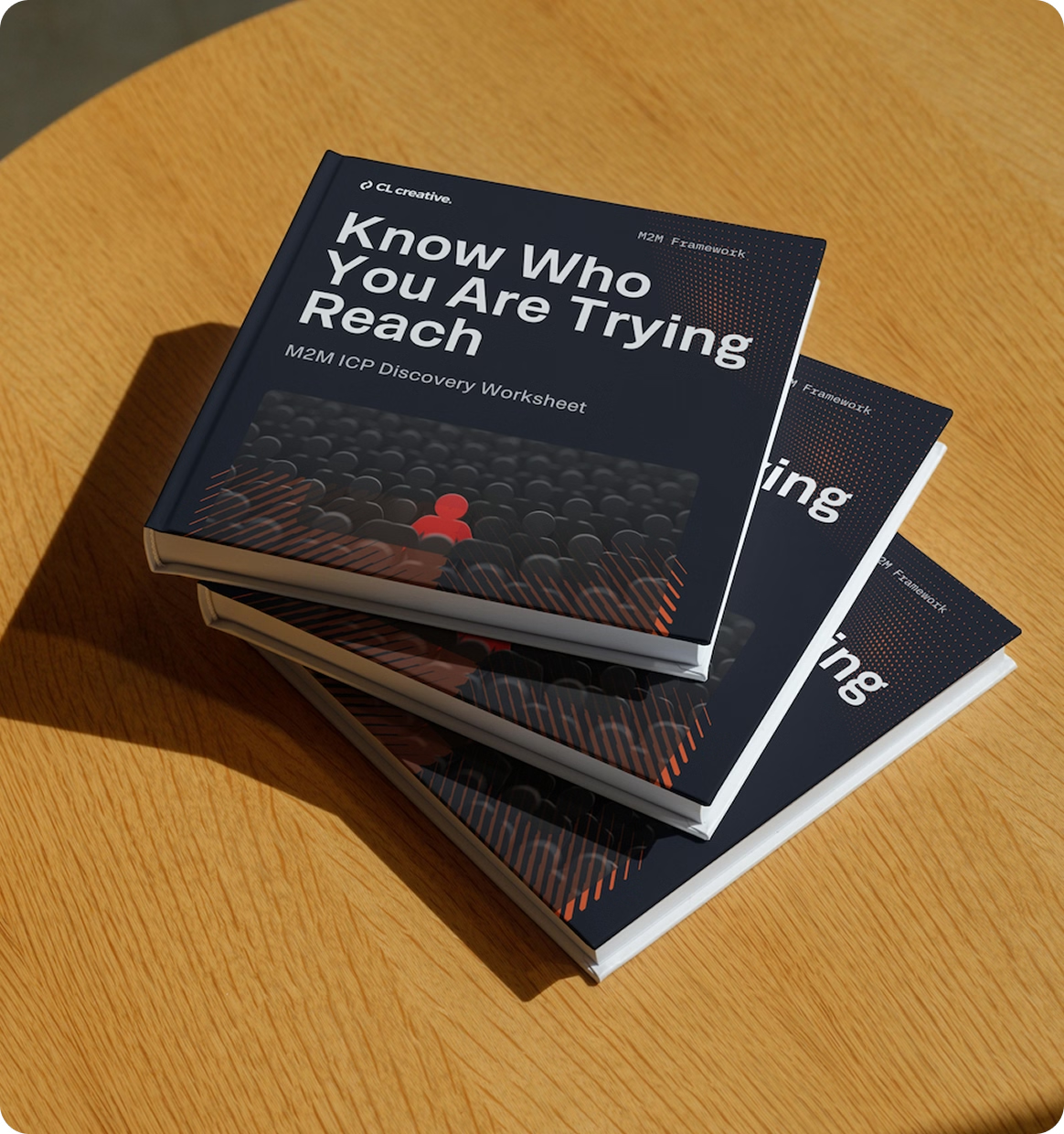
Get the M2M ICP Discovery Worksheet
Know who your website should speak to and what to say.
You've been in business long enough to know what works. Your product is solid. Your customers are happy. Revenue is growing. But somewhere along the way, your website got left behind.
Maybe you built it a few years ago when you were just getting started. Or maybe you hired a designer who made it look great but never asked you a single question about your customers. Either way, it's sitting there. It looks fine. But it's not actually doing anything for your business.
And that's the problem most growth-stage business owners don't realize they have. Their website isn't broken. It's just not built to work.
The Pretty Website Trap
Here's a pattern I see all the time. A business owner hits a certain level of success, usually somewhere around $500K or more in annual revenue, and they decide it's time to invest in their digital presence. They hire a designer or agency, get a beautiful new website, and wait for the leads to roll in.
They don't.
The site looks great in a portfolio. It has nice fonts, smooth animations, and professional photography.
But nobody can figure out what the company actually does within the first five seconds of landing on the homepage.
The messaging is vague. The calls to action are generic.
And the whole thing is built around what the business owner wants to say rather than what their customers need to hear.
I call this the Pretty Website Trap. And it's costing businesses thousands of dollars in missed opportunities every single month.
A study from KrishaWeb found that strategy-led website redesigns generate an average of 3.7x ROI within 4-9 months. Visual-only redesigns? Just 9%. That's not a small gap. That's the difference between a website that pays for itself and one that just sits there looking good.
Why Most Websites Fail at Attracting Customers
Let me ask you a direct question. If someone lands on your homepage right now, can they answer these three questions within five seconds?
- What do you do?
- Who do you do it for?
- How does it help them?
If the answer is no, your website has a messaging problem. And no amount of design polish is going to fix it.
Most business websites fail because they're built backwards. The typical process goes something like this:
- Pick a template
- Choose some colors
- Write some copy about yourself
- Add a "Contact Us" button
- and call it done.
The customer is an afterthought. Their pain points, their goals, the words they actually use to describe their problems. None of that makes it into the final product.
And then business owners wonder why their website gets traffic but no leads. Or worse, no traffic at all.
Here's what the research tells us.
A review published in the Journal of Medicine and Life pulled together multiple studies on how people judge websites, and the findings are hard to ignore.
The first impression of a website forms within 50 milliseconds. That's faster than you can blink. And 80% of people browsing the web spend just a few seconds on a site before deciding to stay or leave.
But here's the number that really matters.
In a large-scale credibility study by Fogg et al., nearly 75% of people said they judge a company's credibility based on how the website looks and how the information is presented.
Not the content itself.
Not the company's reputation or authority.
The design and presentation.
And when researchers showed users the exact same content with different levels of design quality, the better-designed version was rated as more credible 90% of the time.
Your website is often the first real impression someone has of your business.
If it doesn't first look professional, and then speak to them immediately, they're gone. And they're not coming back.
What a Website Messaging Strategy Actually Looks Like
This is where I usually lose people, because when most business owners hear "strategy," they think it means months of planning before anything gets built. That's not what I'm talking about.
What is a website messaging strategy?
A website messaging strategy is about answering one fundamental question before you write a single line of copy or design a single page: who is your customer, and what do they need to hear from you?
That sounds simple. But most businesses skip this step entirely. They assume they know their customer because they've been serving them for years. And they probably do know them on a personal level. But knowing your customer and knowing how to speak to them on a website are two very different skills.
How do you speak to a customer on a website?
Here's what I mean. You might know that your customers are small business owners who need accounting help. But:
- Do you know what specific frustration made them start looking for an accountant?
- Do you know the exact words they'd type into Google?
- Do you know what they're afraid of when it comes to hiring someone new?
- Do you know what "success" looks like to them six months after working with you?
Those answers are what make the difference between a website that converts and one that just exists.
The M2M Framework: A Process That Puts Your Customer First
Over the years, I've developed a process for building websites that actually bring in customers. I call it the M2M Framework, which stands for Market to Message. It's a three-step approach that starts with understanding your market and ends with a website that's built to attract, convert, and grow.
Step 1: Strategy
Before I design or develop anything, I work with clients to understand the customer they're trying to reach. Not in a vague, "who's your target audience?" kind of way. In a deep, specific way that covers:
Who they are.
- What industry are they in?
- What's their role?
- How big is their company?
- What's their revenue level?
- Are they the decision maker, or do they need to convince someone else?
What they care about.
- What are their goals for the next 6 to 12 months?
- What keeps them up at night?
- What have they tried before that didn't work?
- What are they afraid of getting wrong?
How they talk.
- What words do they use to describe their problem?
- How do they describe success?
- What questions do they ask when they're researching solutions?
This isn't a quick survey. It's a real exercise that produces specific, actionable insights. And when it's done right, it gives you a messaging foundation that makes everything else easier.
Your headlines write themselves when you know exactly what your customer is struggling with. Your calls to action get sharper when you know what outcome they're chasing.
Step 2: Design and Develop
Once we have the messaging foundation in place, I take that strategy and turn it into a website that's built around your customer's journey.
- Every page has a purpose.
- Every section answers a question or addresses a concern.
- Every call to action moves the visitor closer to becoming a lead or a customer.
This is where design and development come in. But notice that it comes second, not first. The design serves the strategy. The layout supports the messaging. The user experience is built around what your customer needs to see and do, not what looks coolest in a design tool.
What’s the difference between strategy-first and design-first websites?
The difference is obvious when you compare a strategy-first website to a design-first website.
Strategy First Sites
Strategy-first sites have clear, specific headlines that speak to a real pain point.
Design First Sites
Design-first sites have generic headlines like "Welcome to Our Company" or "Your Trusted Partner in Excellence."
One attracts customers. The other just takes up space.
Step 3: Scale
And here's the step that most businesses skip entirely. The website launches, everyone celebrates, and then nothing happens for the next two years.
The most important part of growing your online presence isn't the launch. It's what happens after.
You need to keep building on that foundation through SEO (Search Engine Optimization), AEO (Answer Engine Optimization, which is how you show up in AI tools like ChatGPT and Perplexity), and social media.
This is where the real compounding happens.
A website with strong messaging and a consistent content strategy doesn't just maintain its results. It grows them.
Month over month, your organic traffic increases. Your brand becomes more visible. And you stop relying solely on referrals and paid ads to keep the pipeline full.
According to projections from Gartner, 25% of search traffic will shift to AI assistants by the end of 2026. If your content isn't structured to show up in those results, you're going to start losing visibility to competitors who figured this out earlier.
What This Looks Like in Practice
Let me show you what this looks like with a real client.
Leverture is a mid-market enterprise agency that came to me with a problem a lot of growing companies have. Their website wasn't keeping up with the business.
They had a WordPress site that lacked the structure and polish to communicate what they actually do for their clients.
- The messaging was generic.
- There were no case studies showing their work.
- No blog content to build credibility or drive organic traffic.
- And they had a conference coming up where they needed to make a strong first impression.
Sound familiar?
A good business with a website that doesn't reflect how good the business actually is.
Here's what we did.
Instead of just giving them a visual refresh, we started with strategy. We dug into who Leverture's ideal clients are, what those clients care about, and what would make them trust an agency with their business. Then we built the entire site around those answers.
We redesigned and rebuilt their website in Webflow with clear messaging that positioned Leverture as the kind of partner their ideal clients were looking for.
We created six dedicated case study pages that showed real results, not just pretty screenshots.
We set up a blog and a tech glossary so they had a content engine to keep driving traffic long after launch. Thirteen pages. Five CMS collections. All done in two weeks.
The result?
Leverture launched their new site ahead of their conference deadline. They walked in with case studies, content, and a digital presence that matched the quality of their work.
The website went from being something they avoided showing people to a tool they were actively using to win new business.
That's the difference between starting with strategy and starting with design. Same company. Same budget. But now the website actually works for them.
How to Know If Your Website Has a Messaging Problem
If you're reading this and wondering whether your current website has this problem, here are five signs to look for:
(1) Your website talks about you more than your customer.
Count the number of times your homepage says "we" versus "you." If "we" wins, your messaging is backwards.
(2) Your headline could apply to any business in your industry.
If you swapped your company name with a competitor's and the homepage still made sense, your messaging isn't specific enough.
(3) You get traffic but no leads.
People are finding you, but they're not taking action. That's a conversion problem, and it almost always traces back to messaging that doesn't connect.
(4) You struggle to explain what makes you different.
If you can't articulate your differentiation in one or two sentences, your website probably can't either.
(5) Your best customers found you through referrals, not your website.
This means your website isn't pulling its weight as a lead generation tool. It's just a digital brochure that people check after they've already been referred.
Start With Your Customer, Not Your Color Palette
If there's one thing I want you to take away from this, it's this: your website should be built for your customer, not for you.
That means starting with research and strategy before you ever think about fonts, colors, or page layouts. Design is important. It validates the message. But you can’t come up with a message that resonates without strategy. Which is why strategy should come first.
Strategy means understanding who you're trying to reach, what they care about, and what they need to hear from you in order to take the next step.
And it means building a website that does the hard work of attracting and converting the right people, so you're not stuck relying on word of mouth forever.
Your business has already proven it works. Now it's time for your website to prove it too.
Free Strategy Session
If you're serious about growing your business this year, I offer a free strategy session where we can look at where you are right now and map out a plan to get your website working as hard as you do.
No pressure, no pitch.
Just an honest conversation about what's possible.

Your Marketing Isn't Bringing in Leads and You Can't Figure Out Why
Score your marketing across 7 key areas in 5 minutes and find out exactly what's holding back your leads and what to fix first.
Questions You Might Be Asking
For most growth-stage businesses, strategy takes one to two weeks. It's not months of planning — it's focused work on understanding your ideal customer, their language, and what they need to hear from you. We run interviews, review your current messaging, and produce a messaging foundation that guides every page. Skip this and design takes twice as long because the team keeps guessing.
Not always. Sometimes the right move is a messaging refresh layered on top of your existing design. If the structure of the site works but the copy is generic or customer-blind, you can get significant lift just by rewriting the core pages with a strategy foundation. A full redesign only makes sense when the current site is technically holding you back or the design no longer fits the quality of the business.
Talk to them. Call five of your best customers and ask what almost kept them from hiring you, what they typed into Google before finding you, and what they tell other people about working with you. Those three questions alone will surface more useful messaging than any internal brainstorm. Their actual words — verbatim — belong on your homepage.
You can absolutely start yourself. Do the customer interviews, write down the exact language your customers use, and audit your homepage against the five signs in this post. That work is free and it's honest. Where most owners get stuck is translating strategy into design and copy that performs — that's when bringing in an outside set of eyes usually pays off. But the thinking starts with you.


