

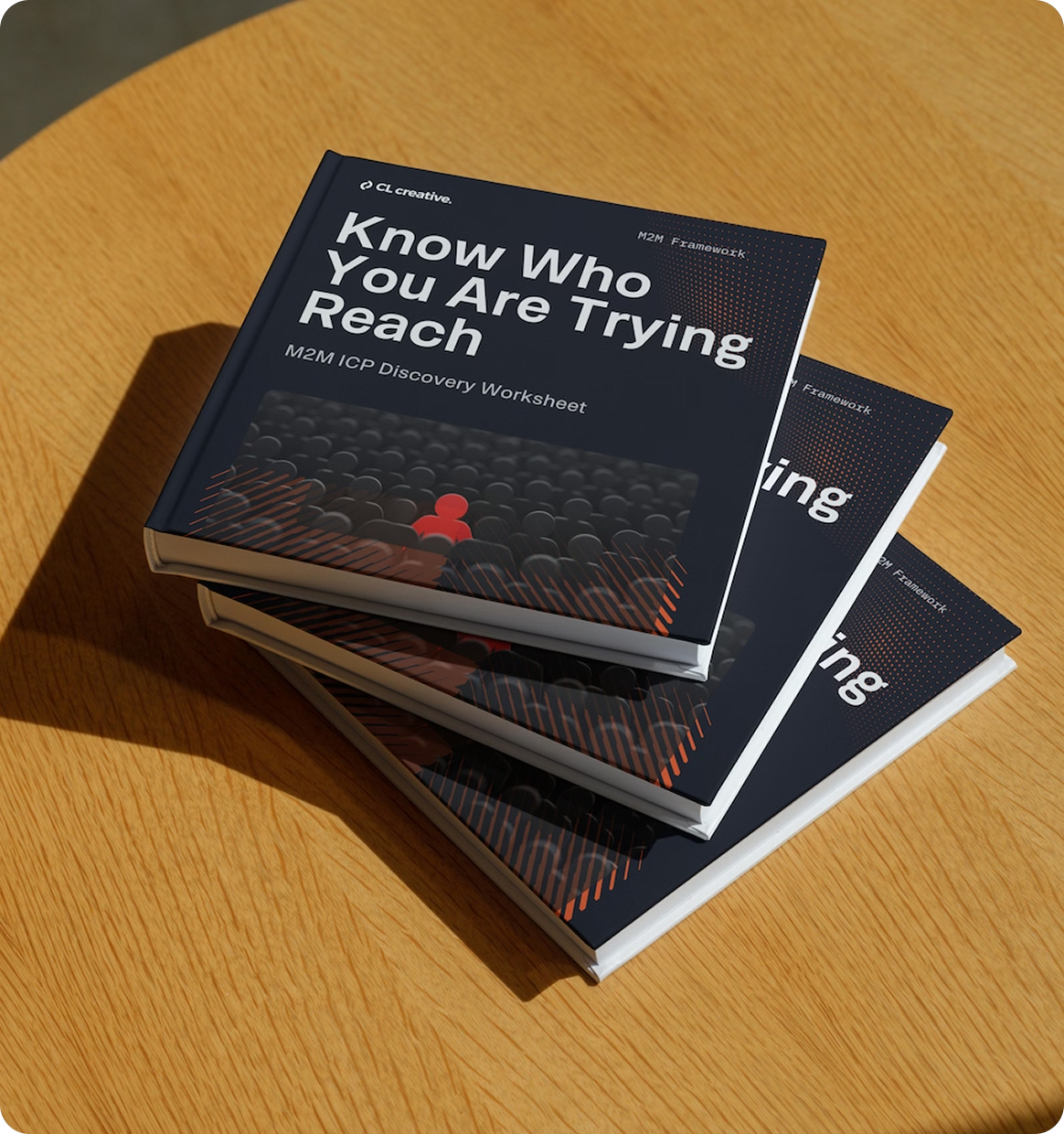
Get the M2M ICP Discovery Worksheet
Know who your website should speak to and what to say.
You're a good consultant. Your clients get results, your renewals happen without a fight, and the work is genuinely worth what you charge. And you still open LinkedIn every Monday morning to send twenty messages to people who have never heard of you.
Nobody warns you about that part. The better you get at the work, the more it costs to keep buying attention one cold message at a time. And marketing for consultants gets sold to you as a volume problem. Send more emails. Post more often. Book more coffees.
I don't buy it. I believe cold outreach is not a marketing strategy for a consultant. It's the tax you pay for being invisible, and you can lower that tax.
So let's talk about what lowering it looks like. Why outreach feels like your only lever, what your buyers are actually doing while you send those messages, and the four moves that bring the right clients to you instead.
Why Cold Outreach Feels Like the Only Option for Consultants
Cold outreach feels like the only option because it's the one channel that pays you back the same day you work it. You send fifty emails, you get a reply or you get silence, and either way you did something you can point to by dinner.
The math is where it falls apart. Average cold email reply rates now sit in the 3% to 5% range across B2B, and one platform-wide benchmark of 2025 to 2026 campaigns puts the average at 3.43%, down from around 8.5% in 2019. Cold email conversion, meaning a signed client, runs closer to 0.2%. That's one client for every 500 emails, and every one of those emails costs you research, personalization, and follow-up you could have spent on client work.
I've watched this cycle run with consultants for years. Month one, outreach works, because a fresh list and fresh energy always produce a few meetings. Month three, replies thin out and you send more to hold the same number. Month six, you land a good project and outreach stops completely because you're delivering. Month nine, the project ends, the pipeline is empty, and you start over on a brand new list. Nothing you built in month one is still working for you in month nine.
Your Buyers Have Mostly Decided Before They Talk to Anyone
By the time a buyer answers a single message, most of their decision is already made. Gartner found that B2B buyers spend only 17% of their total buying time meeting with potential suppliers, and that sliver gets split across every vendor they're considering. Sixty-seven percent of buyers now say they'd rather buy without a rep involved at all. 6sense's research is blunter: the vendor that wins the deal was already on the buyer's Day-One shortlist about 95% of the time.
Notice what that does to a cold message. You're not entering the race. You're knocking on the door of a race that already has a favorite, asking for a spot on a list somebody wrote before you showed up.
Cold outreach doesn't put you on that list. Cold outreach doesn't answer the question they typed into Google at nine at night. Cold outreach doesn't sit in the search results while they compare three consultants. Cold outreach doesn't say a word on your behalf when a colleague asks them who to call.
Something has to do that work while you're busy doing the actual consulting. Something that builds trust before the first conversation instead of asking for it.

What Marketing for Consultants Actually Means
Marketing for consultants means being findable, credible, and easy to hire before the buyer is ready to talk to you. For most consultants the word has shrunk down to mean posting on LinkedIn. Posting is a tactic. Marketing is the system that makes a stranger trust you enough to reach out first, and the reason most business marketing doesn't work is that nobody built the system underneath the tactics.

Think about it this way. Cold outreach is hauling water in buckets. Every gallon you get, you carried, and the water stops the day you stop walking. A marketing system is digging a well. The digging is slow, unglamorous, and produces nothing for a while. Then it produces water every day whether or not you feel like walking to the creek.
At CL Creative we build that well in three steps we call the M2M Framework , market to message. Understand the customer you're trying to reach. Build a message and a site that draw that customer to you. Then scale with SEO, AEO, and content. For a consultant, it comes down to four moves.

Step 1: Decide Who You Help, Then Say It in Their Words
Narrow who you serve until your positioning is a sentence a client could repeat to a friend without you in the room. Vague positioning is the reason most consultants are stuck doing outreach. When nobody can tell what you specialize in, nobody can refer you, and no search brings you up.

Here's what I mean. "Operations consultant for growing businesses" describes a hundred people. "I help construction firms doing five to twenty million in revenue get their job costing under control" describes one, and the person with that exact problem knows in three seconds that you're talking to them.
Write down the problem your best client had in their own words, before they knew what to call it. That sentence becomes your homepage headline, your article titles, and your answer when someone asks what you do. If you want a repeatable process for sharpening it, we walked through writing a compelling value proposition in four steps , and turning all of it into an actual plan is the whole point of how to create a marketing plan for your small business .


Step 2: Make Your Website Do the Work You Keep Doing on Calls
Your site's job is to qualify, explain, and convince while you sleep, so the calls you take are with people who already believe you can help. Most consultant sites do the opposite. They open with a name and a service list, then leave every bit of the persuading to a 45-minute call.
Give the site the four things a buyer checks before they contact anyone: the problem you solve stated in their language, proof you've solved it for someone like them, what working together actually looks like step by step, and a straight answer about pricing or the range to expect. A service business site that turns two to three percent of visitors into inquiries is doing well. Most of the sites I audit sit under one percent, and the gap is almost never traffic. We broke the benchmarks down in what's a good conversion rate for a service business website , and if you'd rather grade the whole thing yourself first, there's a step-by-step marketing audit you can run in an afternoon.


Your Marketing Isn't Bringing in Leads and You Can't Figure Out Why
Score your marketing across 7 key areas in 5 minutes and find out exactly what's holding back your leads and what to fix first.
Step 3: Publish the Answers Your Buyer Is Already Searching For
Write the answers to the exact questions your buyers ask before they hire anyone, because that content is what Google and AI assistants hand them while you're offline. You already have this content. You say it out loud on every discovery call.
Keep a running list of every question you get asked twice. How long does an ERP migration take. What does a fractional CFO cost. What happens if we do nothing for another year. Each one becomes an article that answers the question in the first two sentences and earns that answer over the next thousand words. If you want to pressure-test that list against real search demand, start with how to find the right keywords for your small business . That answer-first format is also what gets picked up by ChatGPT and Perplexity, which now build the shortlist before a human ever lands on your site. More on that in how do I get my business cited by ChatGPT and AI search and the practical version in AEO for service businesses .


The Hinge Research Institute's High Growth Study backs this up from the business side. High growth professional services firms spend about 12% of revenue on marketing, roughly double their slower peers, and they're 2.5 times more likely to put their subject matter experts out front. Visible expertise is the growth channel for consultants, and it doesn't require a marketing department.
Step 4: Give People a Way to Raise Their Hand Before They're Ready to Hire
Add one free resource that solves a small piece of the problem, so buyers who aren't ready for a proposal still get into your world. A consultant with no first step gives a visitor exactly two options: book a call or leave. Most people who are six months out from hiring will leave.
Make it something only you could make. The diagnostic you run in week one. The checklist you work through on every engagement. The model you use to make a build-versus-buy call. Then send something useful every couple of weeks so you're still there when the timing changes. That's the entire nurture strategy, and it beats a monthly "just checking in" email every time. We covered which formats actually pull their weight in lead magnets that actually work for service businesses .

What This Does to Your Referrals and Your Outreach
Now, I don't think this means you delete your prospect list. Outreach stops being cold, which is the real upgrade. When somebody looks you up after your message, and they will, they find a site that names their problem and articles that prove you've solved it. Same message, completely different response.
Referrals get easier too. Your referral sources stop having to explain you. They send a link and your marketing does the explaining, which is why specific positioning produces more referrals than being available to everybody. I've made the harder case about this before in you've built a business on referrals, here's why that's a problem .

And you stop hauling buckets. The well fills whether or not you're standing over it.
How Long Until This Replaces Cold Outreach?
Expect early signals in about 90 days and a pipeline that carries itself in six to twelve months. Search and content compound, and compounding is slow at the start and boring in the middle. That's the trade you're making for something that keeps working after you stop pushing.
I didn't believe this for the first two years of running CL Creative. I sent the emails. I worked the lists. I told myself marketing was something I'd get to when things calmed down. The month I started publishing answers to the questions clients kept asking me was the month strangers started emailing me first, and I wish I'd started eighteen months sooner. We put real timelines against this in how long until a new website or SEO pays off .

Keep outreach running while the system gets built. Just stop treating it as the plan.
Want to know which part of this is costing you the most?
Take the Marketing Scorecard. It takes a few minutes, grades your marketing across seven areas, and gives you your weakest area plus the specific next move to fix it. No call required.
Rather talk it through? Book a 30-minute strategy session. We'll look at your current site, your market, and where your next ten clients would realistically come from, and you'll leave with a clear first move and a rough budget range, whether you hire me or not.
Your marketing is either bringing you clients while you work, or you're the only reason anything shows up in your pipeline. Which one is true right now?
Your Marketing Isn't Bringing in Leads and You Can't Figure Out Why
Score your marketing across 7 key areas in 5 minutes and find out exactly what's holding back your leads and what to fix first.
Questions You Might Be Asking
No, but it works as a supplement, not as a strategy. Reply rates in the 3% to 5% range mean a tight list and a real reason for reaching out can still fill a gap in your calendar. The problem is that outreach stops producing the day you stop sending, while positioning, a working site, and published answers keep producing after you log off.
High growth professional services firms spend around 12% of revenue on marketing, about double their slower-growing peers. For a solo consultant, the number that matters more is time: four to six hours a week on positioning, publishing, and follow-up is enough to build the system. Consistency beats budget in the first year, and a one-page marketing plan is enough structure to keep it honest.
You can do the first part yourself, and you probably should. Your positioning and the list of questions clients ask you can't be outsourced, because they come out of conversations only you are having. Where consultants get stuck is the site build and the publishing rhythm, and that's usually where paying for help returns the most. We compared the options in freelancer vs agency vs marketing partner.
Ten to fifteen articles that each answer a real buyer question will usually start producing search traffic and inbound conversations. Depth beats volume here. One 1,500-word piece that fully answers a question outperforms five thin posts, and AI search tools cite the complete answer, not the summary. Start with the five questions you answer on every discovery call.
Referrals are a reward for past work, not a channel you control. They show up when someone else happens to have the right conversation, which means you can't forecast them or turn them up when you need them. Marketing doesn't replace referrals. It gives your referral sources something to send and makes sure the person who clicks it lands somewhere convincing. I made the fuller case in you've built a business on referrals, here's why that's a problem.


