

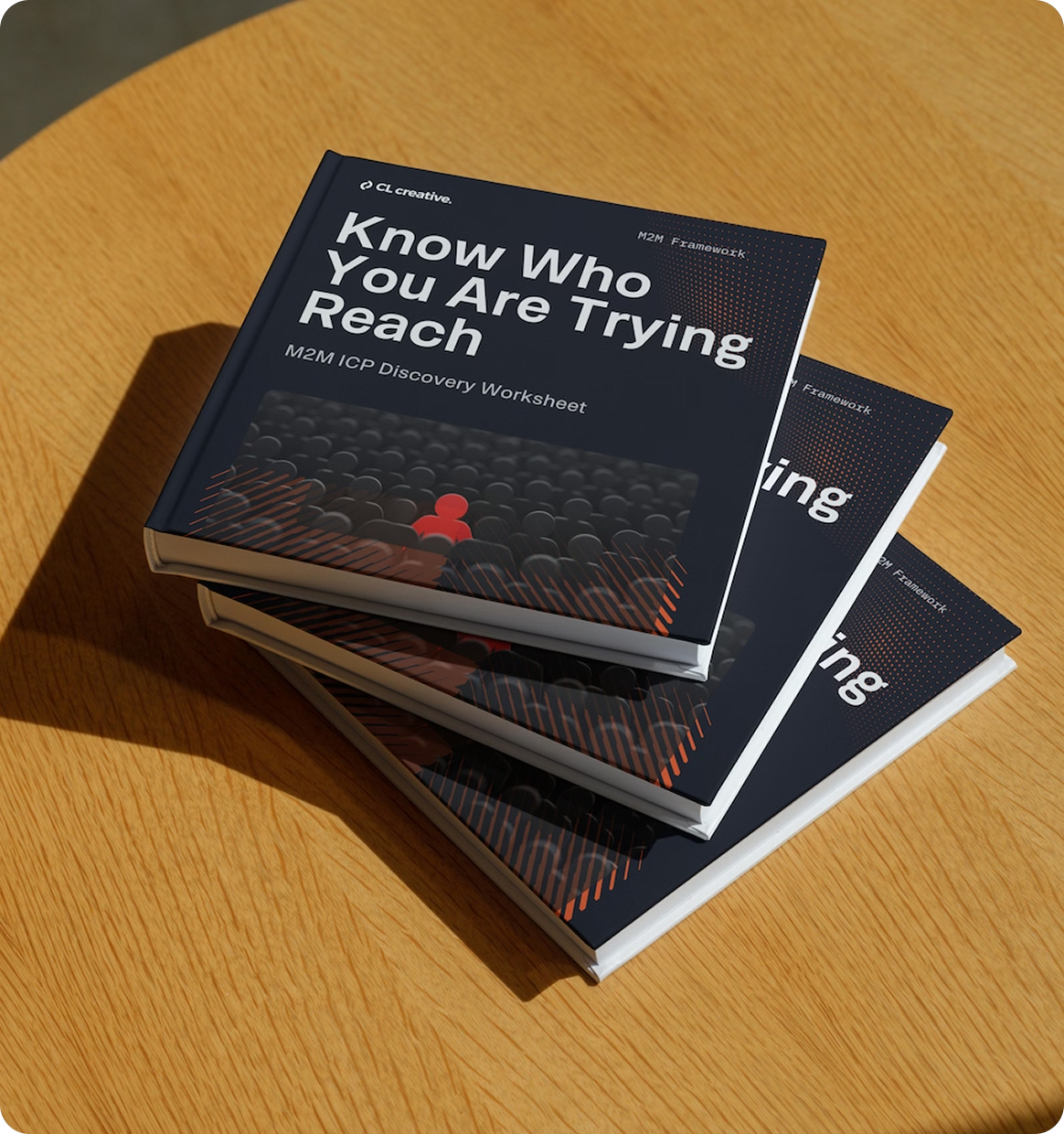
Get the M2M ICP Discovery Worksheet
Know who your website should speak to and what to say.
Open your laptop. Pull up five of your direct competitors. Read the headlines on their homepages.
Now read your own.
If you're being honest, most of them sound like they were written by the same person. Same promises. Same buzzwords. Same vague "we help businesses grow" framing that says everything and nothing at the same time.
This is the wall most growth-stage business owners eventually hit. You're doing good work. Revenue is solid. Referrals come in . But when a prospect lands on your site for the first time, they have no real reason to pick you over the three other businesses they're also looking at. That's the daily reality in Arlington, where Dallas and Fort Worth firms are open in the next two tabs.

That's a positioning problem. And it's fixable.
Why Your Business Blends In With Every Competitor
Here's the thing. Generic messaging is the symptom, not the disease. The disease is that most business owners build a website before they do the positioning work . So the site ends up sounding like everyone else because the thinking underneath it sounds like everyone else.

I see this pattern almost every week.
A business owner reaches out, says they need a new website, and when I ask who they serve, the answer is some version of "businesses that need what we offer."
When I ask what makes them different, the answer is usually "our experience" or "our service" or "our process."
Those aren't differentiators. Every competitor in your market says the exact same thing.
The businesses that stand out aren't the ones with the prettiest websites.
They're the ones who did the work to figure out who they actually serve, what the problem they are solving, how they solve the problem better than anyone else, and why that matters to the customer making a buying decision.
That work is positioning. And it has to happen before the website, before the brand refresh, before the next ad campaign.
Positioning Is Not a Tagline. It's a Decision.
A lot of business owners hear the word "positioning" and think it means coming up with a clever tagline. It doesn't.
Positioning is a set of decisions about three things:
- Who you serve. Not "businesses." Not "companies that need marketing help." A specific type of customer with a specific situation.
- What you do for them. Not your service list. The actual problem they hire you to solve and the outcome they hire you to create.
- Why you're the obvious choice. What makes you different in a way that matters to them, not in a way that matters to you.
If you can answer those three questions clearly, your messaging writes itself. If you can't, no amount of design work, copywriting, or ad spend will fix it.
A tagline is what comes out of positioning. It's not the work itself.
Step 1: Get Specific About Who You Actually Help
The first instinct most business owners have when I bring this up is to push back. "If I get too specific, I'll lose business."
It feels counterintuitive, but the opposite is true.
When you try to talk to everyone, you talk to no one.
When you talk directly to a specific person about their specific situation, that person feels seen. They reach out. They convert.
Here's a quick exercise. Look at your last ten clients. Ask yourself:
- Which three were the best to work with?
- What did those three have in common?
- Where were they in their business when they hired you?
- What problem were they trying to solve?
- What had they already tried that wasn't working?
The pattern that shows up in that exercise is your real ICP.
That's the person your website should be talking to. Not "any business that wants to grow." That specific person, with that specific problem, at that specific stage.
This is the first step in the M2M Framework I use with every client. Before we touch design or copy, we figure out exactly who we're trying to attract. Because if you don't know that, nothing else can be sharp.
Step 2: Find the One Thing You Do Better Than Anyone Else
The second trap is the list-everything approach. Business owners want their website to communicate every service, every capability, every angle they can sell. So the homepage becomes a long list of bullet points and feature blocks that reads like a brochure.
The problem is that when you list ten things, none of them stand out. Your prospects can't tell what you're actually known for. Neither can search engines. Neither can the AI tools your buyers are starting to use to shortlist providers.
To find your real differentiator, ask yourself a hard question:
What is the one outcome you create for your best clients that your competitors either can't create or won't talk about?
It's almost never a feature. It's usually some combination of:
- A specific result you produce consistently (a measurable business outcome).
- A specific way you work that solves a frustration your competitors create (founder access, faster delivery, deeper strategy, real training).
- A specific perspective you bring that no one else in your market is talking about (a framework, a philosophy, a contrarian point of view).
For me, that's the M2M Framework. I don't just build websites. I help growth-stage business owners get clear on their market and their messaging before I write a single line of code. That's the thing that's different. It's the thing my best clients tell their friends about. So that's what my positioning is built around.
You have something similar. You just might not have named it yet.
Step 3: Rewrite Your Messaging Around the Decision Your Customer Is Making
Once you know who you serve and what you do better than anyone else, your messaging stops being about you and starts being about the decision your customer is actively trying to make.

Here's what I mean. Most websites lead with self-focused statements:
- "We are a full-service marketing agency."
- "Our team has 20 years of combined experience."
- "We offer custom solutions for every client."
None of that helps a prospect decide anything. It's just description. It could apply to any of your competitors.
Compare that with positioning-driven messaging that names the problem, states the solution, and points to the result — the same three ingredients in every tagline that actually works:
Web design studio (for growth-stage service businesses):
- Problem → "For growth-stage business owners stuck running on referrals…"
- Solution → "…a strategic Webflow site that turns positioning clarity into consistent qualified leads."
- Result → "So your site doesn't just look good. It works."
Bookkeeping firm (for small business owners):
- Problem → "For business owners who dread tax season…"
- Solution → "…clean books every month so you always know what you owe and what you keep."
- Result → "You stop chasing receipts and start running your business."
Fitness coach (for men over 50):
- Problem → "For men over 50 who feel like their best years are behind them…"
- Solution → "…a strength program built for your body, not a 25-year-old's."
- Result → "You add 10 years to your life and outplay the guys your age."
Financial advisor (for young families):
- Problem → "For new parents worried they're already behind on saving…"
- Solution → "…a clear plan so you stop guessing and start building."
- Result → "Your kids' future doesn't depend on your luck or the market."
Estate planning attorney (for parents who keep putting it off):
- Problem → "For families who keep saying 'we'll get to it'…"
- Solution → "…an estate plan in 30 days, not 30 years of paperwork."
- Result → "Your kids never have to guess what you wanted."
Interior designer (for new homeowners):
- Problem → "For new homeowners staring at empty rooms with no idea where to start…"
- Solution → "…a room-by-room plan you'll actually finish."
- Result → "Your house finally feels like yours."
HR consultant (for growing businesses):
- Problem → "For founders making their first 10 hires…"
- Solution → "…HR systems built before you need them."
- Result → "Growth doesn't cost you your team or your culture."
Notice the pattern. Industry doesn't matter. The structure does. Every one of these:
- Names the problem in the customer's own words (the survival liability)
- States the solution plainly, with no jargon (the answer)
- Points to the result the customer is actually buying (the survival asset)
The difference between these and generic messaging is specificity. The reader can tell immediately if it's for them or not. And if it is for them, they keep reading.
A few rules I follow when rewriting messaging this way:
- Lead with the customer's situation, not your company.
- Use the words your customer would use, not the jargon your industry uses.
- Answer the questions a buyer is asking before they ask them out loud. ("Is this for someone like me?" "What problem does this actually solve?" "Why should I choose you over the others?")
- Cut anything that could be copied and pasted onto a competitor's site without changing a word.
That last rule is the biggest one. If your headline still makes sense on a competitor's homepage, it's not really yours.
How to Test Whether Your Positioning Is Actually Working
How do you know if any of this is landing? You watch the signals.
Signs you're still blending in:
- Sales calls start with "so tell me about what you do" and last forty-five minutes before the prospect understands the offer.
- Most of your inbound leads ask for a quote before they understand your value.
- You compete on price more often than you'd like.
- You feel like you have to convince people you're different.
- Referrals come in describing you in completely different ways depending on who's referring.
Signs your positioning is working:
- Prospects show up to discovery calls already half-sold. They've read the site. They know who you serve. They've decided you might be a fit before you talk.
- Sales cycles get shorter.
- Bad-fit leads disqualify themselves before they ever fill out the form.
- Clients describe you in similar language across the board, often using phrases pulled directly from your website.
- You can charge premium pricing without it being a fight every time.
Positioning isn't a vanity project. It's a revenue lever. When it's working, you feel it in your pipeline. When it's not, you feel it in the silence after a proposal goes out.
Ready to figure out what makes your business actually different?
Every growth-stage business has something that makes it different. Most just haven't done the work to name it, sharpen it, and build their messaging around it.
That's the work I do with every CL Creative client before we ever talk about design or development. It's the part of the process that turns a good website into a real lead generation engine.
I offer a 30-minute strategy session where we walk through your market, your best clients, and what your real positioning could be. You'll leave with a clearer picture of what makes your business different and a starting point for messaging that doesn't sound like every competitor, whether you hire me or not.
Not quite ready to talk? Explore the M2M Framework. It's the same customer-and-messaging framework I use on every project, so you can start sharpening your positioning before you hire anyone.

Your Marketing Isn't Bringing in Leads and You Can't Figure Out Why
Score your marketing across 7 key areas in 5 minutes and find out exactly what's holding back your leads and what to fix first.
Questions You Might Be Asking
For most growth-stage businesses, the strategic positioning work takes between one and two weeks of focused effort. That includes interviewing past clients, analyzing competitors, and writing the core messaging framework. The website build that comes after it takes longer, but the actual positioning decisions don't take months. They take focus.
No. A rebrand is a visual change. Positioning is a strategic change. You can sharpen your positioning without touching your logo, your colors, or your name. Most of the work happens in your messaging, your homepage, and the conversations your sales process is built around. The visual brand can stay consistent. The story it tells just gets sharper.
That's normal for established businesses. The answer is usually to pick a primary ICP for your homepage and main marketing, then build secondary pages or service lines for the other audiences. Your homepage talks to one person. Your service pages can talk to others. Trying to talk to everyone on the same page is what causes the blending-in problem in the first place.
Yes, especially if you're willing to slow down and do the customer research work yourself. Talk to ten of your best clients. Ask them why they hired you, what they almost hired instead, and what's changed for them since. The answers will tell you what your real positioning is. The hard part is being objective about your own business, which is where an outside perspective helps. But the work itself is doable in-house if you have the time and discipline.
A lot. Search engines and AI tools both reward specificity. When your site clearly states who you serve, what you do, and how you do it differently, search algorithms have something concrete to rank. AI tools like ChatGPT and Perplexity have something specific to cite when someone asks them for recommendations in your space.
Generic positioning produces generic search results. Sharp positioning produces a discoverable, citable business. This is why positioning isn't separate from marketing strategy. It's the foundation underneath everything else.
Trying to fix the website before fixing the strategy. A redesign on top of generic positioning just produces a prettier version of the same problem. Always do the positioning work first. The website will be ten times more effective when it's built on top of a clear answer to "who do we serve, what problem do they have, and why should they choose us."


