

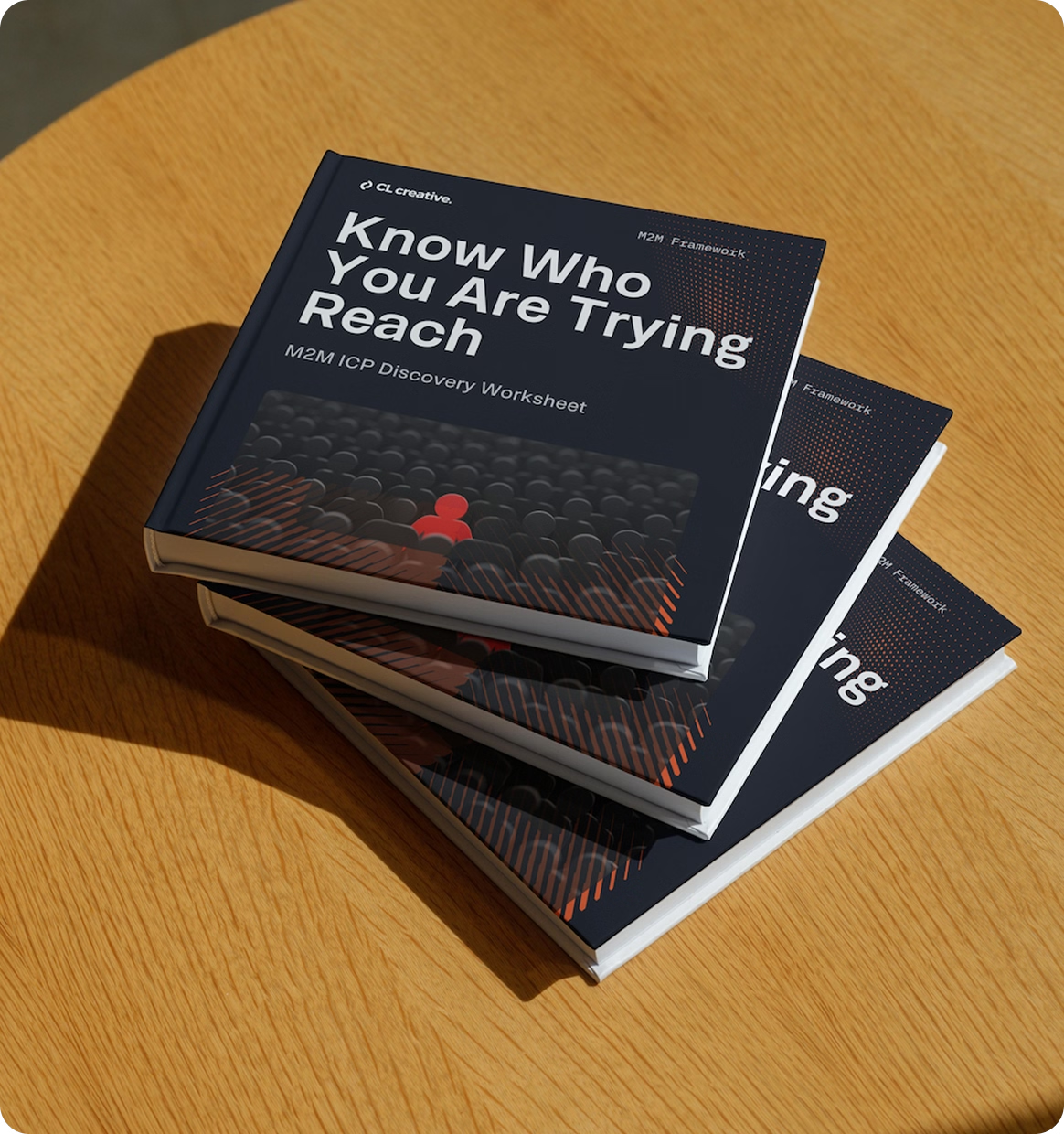
Get the M2M ICP Discovery Worksheet
Know who your website should speak to and what to say.
You've got a business that's working. Revenue is solid. Clients are happy. But your website? It's not pulling its weight. Maybe it looks fine. Maybe it even looks great. But it's not bringing in the right kind of leads, and you can't figure out why.
Here's the thing most business owners miss. The problem usually isn't your design . It isn't your logo. It isn't even your offer. It's that your website is talking, but nobody on the other end feels like you're talking to them.

That's the problem the M2M Framework solves.
What M2M Actually Stands For

M2M stands for Market to Message. It's the approach I use at CL Creative to make sure every website I build speaks directly to the person it's trying to reach.
The framework breaks down into three steps:
- Know Your Market
- Refine Your Message
- Build and Grow
Each step builds on the last. You can't skip one without weakening the whole thing. And if you've ever looked at your website and thought, "This doesn't feel like us," or "This isn't attracting the right people," you've probably skipped one of these steps.
Let me walk through each one.
Step 1: Know Your Market
Most businesses think they know their audience. They'll say something like, "We work with small business owners," or "Our clients are growth-stage companies."
That's not enough.
Knowing your market means knowing the specific person you want to attract. Their role. Their revenue. Their biggest frustrations. The language they use when they talk about their problems. What are they searching for at 11 p.m. when they can't sleep? What have they already tried? What are they afraid of?
This is where the Ideal Customer Profile (ICP) comes in. Not a persona with a fake name and a stock photo. A real, specific description of the person you want on a call with you next week.
When you know this person, everything else gets easier. Your copy writes itself. Your design decisions stop being arbitrary. Your content starts to actually pull in leads.
Step 2: Refine Your Message
Once you know who you're talking to, you can figure out what to say.
This is the step where most agencies fall down. They'll take a client brief, write some generic copy about being "innovative" or "solution-focused," and call it done. Then the client wonders why their conversion rate is stuck at one percent.
Refining your message means taking everything you learned in Step 1 and turning it into copy that sounds like a friend who happens to solve your exact problem. Not a vendor. Not a brochure. A person.
This shows up in a few ways:
- Headlines that name the exact pain point your ICP is feeling
- Body copy that uses their language, not yours
- CTAs that match where they are in the buying journey
- Proof points that speak to the objections they're actually having
If your website is full of generic claims, you haven't done this step yet. If your bounce rate is high and your conversion rate is low, you haven't done this step yet.
Step 3: Build and Grow
This is where most people start. It's also the reason most websites underperform.
Once you've nailed the first two steps, building the site becomes the easy part. The design supports the message. The structure guides the visitor to the next action. The SEO and AEO work is built on a foundation that actually reflects how your ICP searches and asks questions.
Growing the site from there (with SEO, AEO, content, and social) becomes a multiplier instead of a hope. You're not throwing content at a wall. You're creating assets that attract the exact person you built the site for.
This is why an M2M-built website keeps getting better over time. Every blog post, every service page, every landing page reinforces the same message to the same market.
Why This Matters More in 2026
A few years ago, you could get away with a decent-looking website and some basic SEO. Traffic was cheap. Ads worked. Referrals carried you.
That's not true anymore.
Buyers are researching longer before they contact you. They're asking ChatGPT and Perplexity for recommendations before they even land on your site. They're comparing five agencies before they book a call with one.
If your website doesn't immediately speak to the exact person you want to attract, they're gone. And if your content isn't built around the specific questions your ICP is asking, AI tools like ChatGPT won't recommend you.
M2M isn't just a nice-to-have anymore. It's the difference between a website that costs you money and a website that earns you money.
What the M2M Framework Is Not
A few quick things to clear up.
M2M is not a template. I don't plug every client into the same copy formula. The whole point is that the copy comes from your specific ICP's language and pain points.
M2M is not a one-time exercise. Your market shifts. Your ICP gets clearer. Your message should evolve with it.
M2M is not a replacement for good design or strong development. It's the strategic layer that makes the design and development actually work.
How to Tell If Your Website Needs M2M
Ask yourself:
- Does your homepage hero tell a stranger exactly who you help and what you do within three seconds?
- If you showed your site to your ideal customer, would they feel like you were speaking directly to them?
- Does your content answer the specific questions your buyers are asking?
- Can you name three specific pain points your ICP has, and can you point to where your site addresses each one?
If you answered "no" or "not sure" to any of these, your website has a messaging problem, not a design problem. And a redesign won't fix it.
What to Do Next
If this sounds like your site, the next step is to start with Step 1. Get clear on who you're trying to reach. You can grab the free M2M ICP Discovery Worksheet to start working through it yourself, or book a strategy session and we'll work through it together.
And if you want the full walkthrough of how the M2M Framework works in practice, the M2M Framework hub page has the whole thing broken down with examples.
The goal isn't a prettier website. The goal is a website that brings you the right kind of leads, every week, without you having to chase them.
That's what M2M is built to do.

Your Marketing Isn't Bringing in Leads and You Can't Figure Out Why
Score your marketing across 7 key areas in 5 minutes and find out exactly what's holding back your leads and what to fix first.
Questions You Might Be Asking
M2M stands for Market to Message. It's a three-step strategic framework used at CL Creative to align a business's website with the specific audience it's trying to attract. The three steps are:
- Know Your Market
- Refine Your Message
- Build and Grow
A brand strategy typically focuses on positioning, voice, and visual identity. The M2M Framework is narrower and more actionable. It's built specifically to make your website convert better by grounding every design and copy decision in research about your ideal customer.
Yes, it is a recommended approach. That’s because skipping Step 1 or Step 2 and jumping straight to Step 3 (Build and Grow) is the most common reason websites underperform. The build should be the expression of the strategy, not a replacement for it.
For most projects, the strategy phase (Steps 1 and 2) takes one to two weeks. It depends on the time you have to answer the initial questions. The sooner those are answered, the faster the strategy process can keep moving. The build and launch phase varies based on the project scope, usually four to six weeks.
Absolutely. In fact, most clients come to me with an existing site that isn't performing. We start with an M2M audit to find the gaps, then decide whether the fix is a messaging overhaul, a targeted page rebuild, or a full redesign.


