

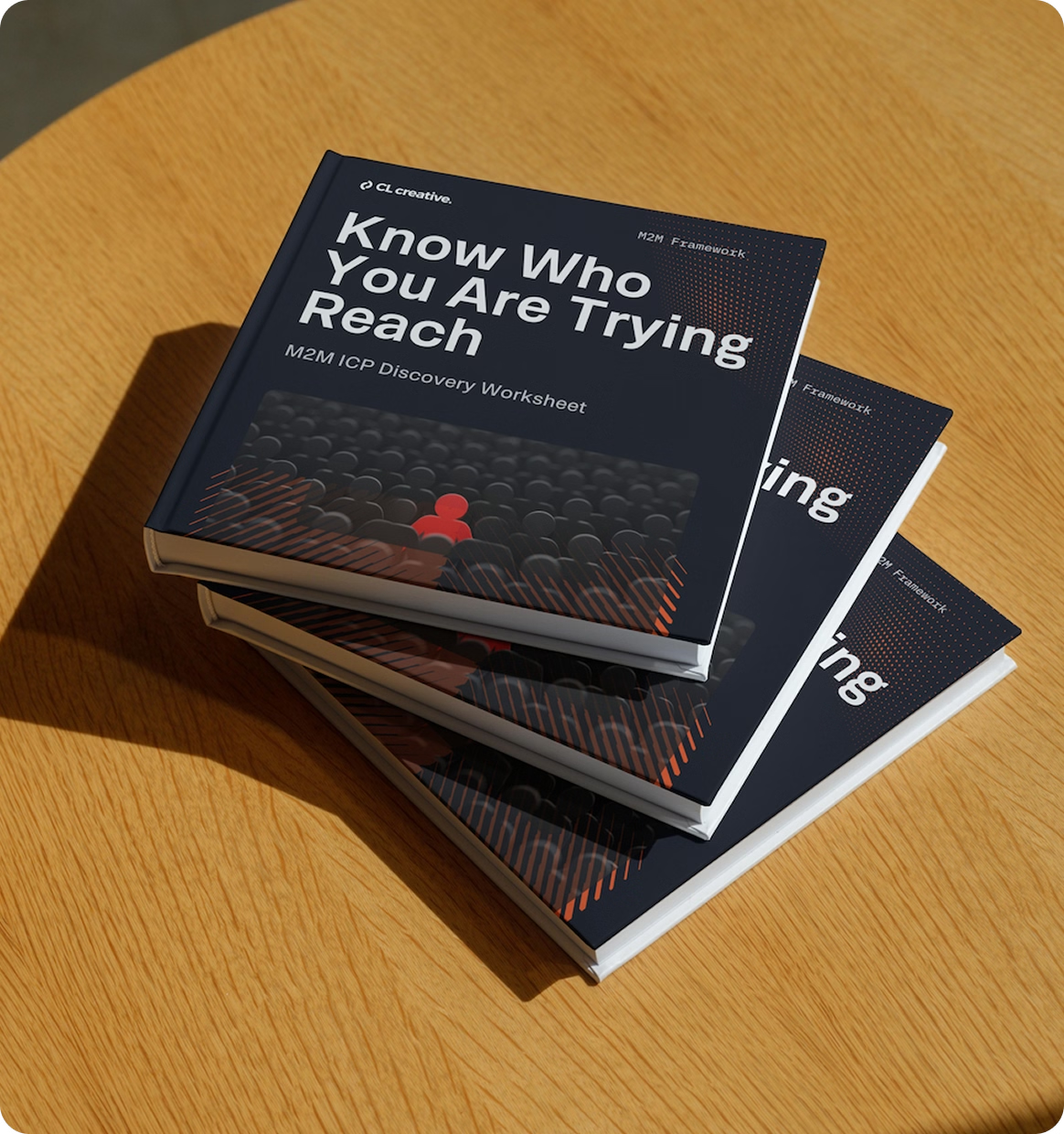
Get the M2M ICP Discovery Worksheet
Know who your website should speak to and what to say.
Your business is doing well. You've got clients. Revenue is solid. And if someone asks how you get most of your business, the answer comes easy: "Referrals and word of mouth."
It sounds like a good thing. And for a while, it is.
But here's the part nobody talks about. A business built entirely on referrals is a business built on something you can't control. And the moment those referrals slow down, you don't have a backup plan. You have a problem.
Referrals Are Great. Until They're Not.
Referrals feel safe because they come with built-in trust. Someone vouched for you, so the new prospect already has confidence before the first conversation. That's powerful.
But here's what referrals can't do:
- They can't scale on demand. You can't decide you need 10 more clients this quarter and make 10 referrals appear.
- They can't be predicted. Some months you get three. Some months you get zero. There's no pattern and no pipeline.
- They can't reach people who've never heard of you. Referrals only travel through your existing network. That network has limits. In a college town like Denton, where a chunk of your market moves away every spring, you hit those limits faster than most.
If your entire growth strategy depends on other people remembering to mention your name at the right time, you're not running a growth strategy. You're running on luck.
The Referral Ceiling Is Real
There's a point where every referral-based business hits a wall. You've tapped out your immediate network. Your past clients have already sent everyone they know. And the flow of new leads slows to a trickle.
This is what I call the referral ceiling. And it hits harder than most business owners expect.
When you're under that ceiling, everything feels urgent.
- You start saying yes to projects that aren't a great fit because you need the revenue.
- You lower your prices to close deals faster.
- You spend more time chasing leads than doing the work you're actually good at.
None of that is sustainable. And none of it had to happen.
The Real Problem Isn't Referrals. It's Relying on Them.
Let me be clear. Referrals are a good thing. I'm not telling you to stop accepting them. I'm telling you to stop depending on them as your only source of business.
Think about it this way. If someone pulled the plug on your referral network tomorrow, every single person who's ever sent you a client just stopped, how would new clients find you?
If the answer is "I'm not sure," that's the problem.
Most business owners in this situation know their website isn't pulling its weight. They know their online presence is outdated or generic or both. But because referrals have been covering the gap, they've never had to deal with it.
Until now.
What an Organic Digital Presence Actually Does
When I talk about building an organic digital presence, I'm not talking about posting on social media three times a week and hoping for the best. I'm talking about building a system that brings qualified leads to your door without you having to ask for them.
Here's what that looks like in practice.
(1) Your website becomes a sales tool, not a brochure.
Instead of listing what you do and hoping visitors figure out if you're a fit, your site speaks directly to your ideal customer.
- It calls out their specific problems.
- It shows them you understand their situation.
- And it gives them a clear next step.
(2) Your content builds trust before the first conversation.
Blog posts, case studies, and educational content do the heavy lifting that referrals used to do.
A prospect reads three of your articles, watches a video, and by the time they book a call, they already trust you.
That's a shorter sales cycle and a higher close rate.
(3) SEO and AEO compound over time.
Every piece of content you publish is an asset that keeps working. A blog post you write today can bring in leads six months from now. A year from now. That's the opposite of referrals, which are one and done.
Search engine visibility and showing up in AI-powered answer tools like ChatGPT and Perplexity means your business gets found by people who are actively looking for what you do. Not people who happened to hear your name at a dinner party.
Referrals Are a Bonus. Your Website Is the Engine.
The best businesses I work with still get referrals. Plenty of them. But referrals aren't the foundation. They're the cherry on top.
The foundation is a website that's built on real strategy.
It starts with understanding who your ideal customer is and what they actually care about.
Then building messaging that speaks to those people specifically.
And then designing and developing a site that turns that messaging into leads, calls, and revenue.
That's the approach I take with every client through my M2M Framework.
- It starts with your market, the people you're trying to reach.
- Then moves to your message, what you say and how you say it.
- And then it scales through SEO, AEO, and content that compounds over time.
It's not complicated. But it does require being intentional about your online presence instead of treating it as an afterthought.
What This Looks Like for a Business Like Yours
Let's say you're doing $500K or more in revenue. Business is good, but growth has plateaued. You get most of your clients through referrals and word of mouth. Your website exists, but it's not doing much.
Here's what changes when you invest in your digital presence.
Month one.
You get clear on who your ideal customer is and what messaging will resonate with them. Your website gets rebuilt around that strategy, not just around looking good.
Months two through three.
Your new site goes live. Content starts getting published. You begin showing up in search results for the terms your ideal customers are actually searching for.
Months four through six.
The compound effect kicks in. Organic traffic grows. Leads start coming in from people who found you through Google or AI search tools. Your sales calls get easier because prospects already know who you are and what you do.
Month six and beyond.
Referrals are still coming in, but now they're adding to a pipeline that's already full. You're choosing clients instead of chasing them. That's a very different business to run.
You Don't Have to Keep Hoping the Phone Rings
Here's what it comes down to. You've done the hard work of building a business that people want to refer. That's not nothing. It means your product or service is good. It means people trust you enough to put their name on it.
But trust from referrals only gets you so far. At some point, you need a digital presence that does the same thing, builds trust, answers questions, and converts visitors, at scale and on autopilot.
If your website isn't doing that right now, it's not a website problem. It's a strategy problem. And it's one worth solving before the next dry spell hits.
I offer a free strategy session where we look at where you are right now, where you want to go, and what's standing between the two. No pitch, no pressure. Just a real conversation about what it would take to build a growth engine that doesn't depend on other people remembering your name.

Your Marketing Isn't Bringing in Leads and You Can't Figure Out Why
Score your marketing across 7 key areas in 5 minutes and find out exactly what's holding back your leads and what to fix first.
Questions You Might Be Asking
You don't have to choose. Keep nurturing referral relationships the way you always have — stay in touch, do great work, ask for introductions. The shift is adding a second channel that runs in parallel. Start with a website that speaks directly to your ideal customer and one piece of content per month that earns search visibility. That's it. You'll feel the compound effect within six to nine months without disrupting your existing pipeline.
A strategic website rebuild typically runs in the $10K to $25K range, and ongoing content plus SEO is usually $2K to $5K per month depending on ambition. Compared to paid ads, where you stop getting leads the moment you stop spending, organic builds an asset you own. For most businesses doing $500K+ in revenue, reallocating even a modest portion of the marketing budget to organic pays off within a year.
Plan for three to six months before you see consistent inbound. The first 30 days are site and messaging. Months two and three are getting content out and letting search engines find it. Months four through six are when the compounding kicks in and qualified leads start landing without you hunting for them. Anyone promising leads in week two is selling ads, not organic growth.
You can do pieces yourself — especially the customer research and subject-matter content — since no one knows your clients better than you. But the strategy, site architecture, and SEO execution are usually where in-house efforts stall. If you've got someone on staff with real experience, lean on them. Otherwise, partnering with a specialist for the foundation and keeping content in-house tends to be the best mix.


