

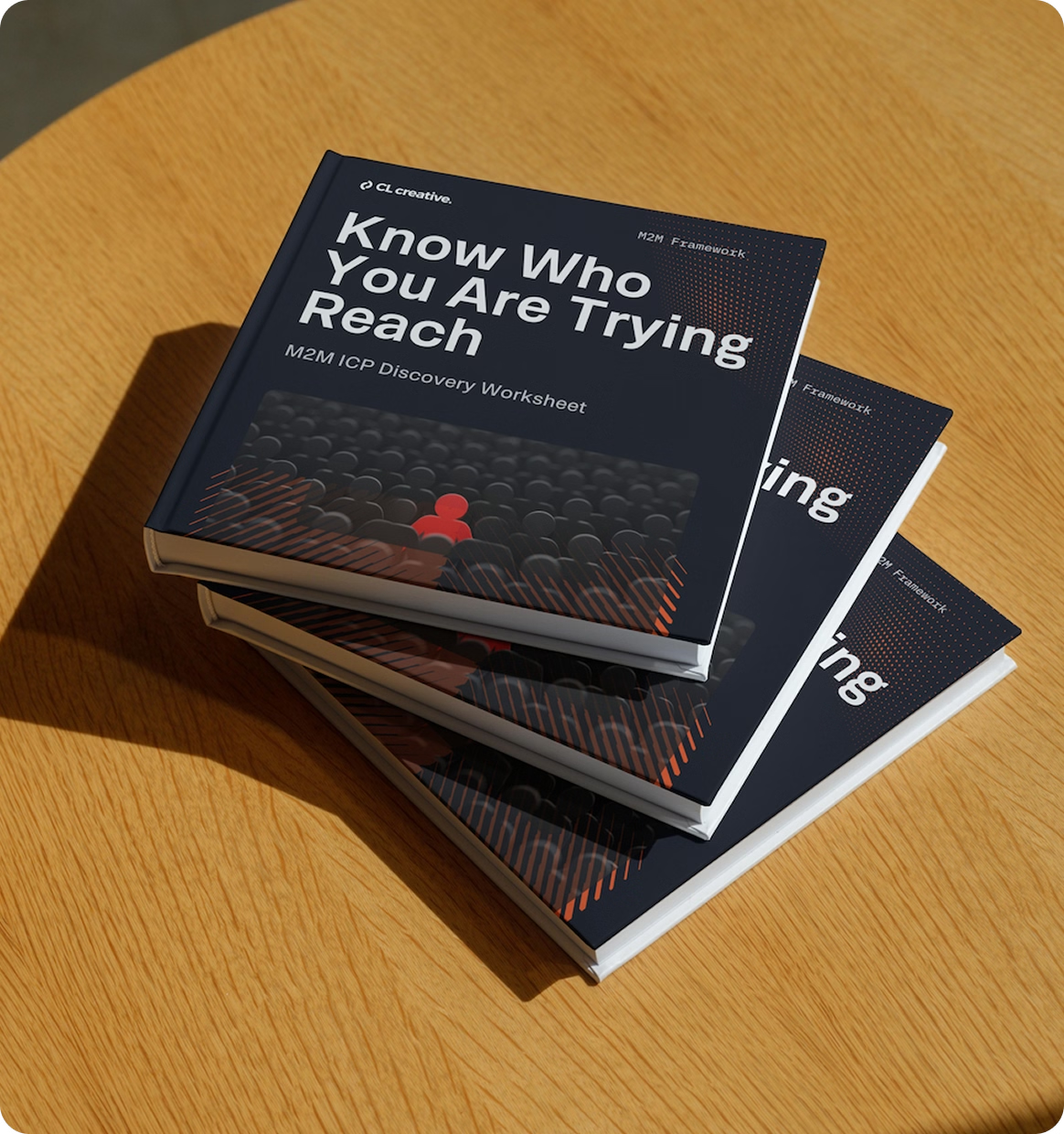
Get the M2M ICP Discovery Worksheet
Know who your website should speak to and what to say.
You've narrowed the agency search down to a few options. The portfolios look fine. The pitch decks all sound similar. But none of them will tell you what working with them is actually going to feel like once the contract is signed and the kickoff call ends.
I get why. Most agencies stay vague on purpose because their process is vague. Mine isn't, and I'd rather you see the whole thing before you commit. So this is what eight weeks with CL Creative looks like, week by week, including what you'll be doing alongside me.
Quick note before we start. Most projects run six to ten weeks. I'm walking through a standard eight-week build below. Faster builds happen when content is ready and decisions move quickly. Longer ones happen when copy, photography, or stakeholder alignment slip.
The big picture
Every CL Creative project runs through three phases that map to the M2M Framework I use with every client.

- Phase 1: Know Your Market . The ICP Discovery Workbook, the kickoff conversation, and the messaging foundation every page is built on.
- Phase 2: Refine Your Message . Sitemap, copy, wireframes, and visual design.
- Phase 3: Build and Grow . Webflow development, QA, launch, and the handoff that helps you actually run the site after I'm done.


Phase 1 matters more than phases 2 and 3 combined.
If we don't get clear on your customer and your message in phase 1, the design and development that come after it are educated guesses.
You'll end up with a better-looking site that converts about the same as the one you have today.
Week 1: Information exchange and kickoff
Week one is about getting the right information moving in both directions before we start building anything.
Before our kickoff call, I'll ask you to:
Send me two or three websites you like, with a few notes on each one.
What you like, what you don't, what you'd steal, what you'd change. Doesn't have to be in your industry. I'm trying to understand your visual taste and what feels right to you.
Start filling out the ICP Discovery Workbook.
This is a deep set of questions about both your customers and your business:
- Who your ideal client is
- What they're trying to solve
- The language they use
- What almost stopped them from buying
- Your existing best customers and what they have in common
- Your competitive positioning
- The depth of value you actually provide
- How you talk about your work
- The proof you've already built
It's the foundation for every messaging and design decision in the project. You don't need to finish it before the call. Get as far as you can.
Send over any assets that help me learn about your company.
Logos, brand guidelines, photography, brochures, pitch decks, sales decks, case studies. The more I see, the faster I can get up to speed.
Give me access.
I usually need access to Google Analytics and Search Console (and your CRM or email platform if you have them) so I can see where you're starting from.
What we cover on the kickoff call (about 90 minutes):
- The two or three sites you sent me. We talk through what's working in each one, what isn't, and what that tells us about the design direction for yours.
- A walk-through of where you are right now. Current site, current pipeline, what's working and what isn't.
- The ICP Discovery Workbook. We go through whatever you've already started, make sure the questions are clear, and I help you sharpen the answers in real time.
What you'll have at the end of the week
A clear picture of what we're building and why. You'll also have a head start on the workbook that becomes the foundation for the rest of the project.
A quick note on customer research. I'll encourage you to pull from real customer language wherever you can. Sales call recordings, support emails, reviews, anything you've already got. If you can't get that level of detail in a week, don't let it block you. We can work with what you have and refine later.
Week 2: ICP Workbook review
This is the meeting that decides whether the rest of the project converts or just looks pretty.
What we cover on the call:
- A full walk-through of your finished ICP Discovery Workbook.
- Where the answers feel sharp and where they feel like guesswork. I'll push back where the answers don't match what I'd expect to see in your sales pipeline or the customer language you've shared.
- The throughline that's going to show up across the homepage, services pages, and CTAs. Your positioning, your proof, and the words your buyers actually use.
What you'll have at the end of the week
A workbook that's been reviewed, refined, and is ready to drive every messaging and design decision from here on out. This is the document I keep open every time I write a line of copy or place a CTA on the new site.
Week 3: Sitemap, copy, and the start of wireframes
Now we put the workbook to work.
What I'm doing:
- Mapping the full sitemap based on how your buyers actually move through a decision, not your internal org chart.
- Writing the homepage and core service page copy directly from the workbook. Your words and proof, sharpened into messaging that does the work.
- Drafting meta titles, descriptions, and primary keywords for each page so SEO is baked in from the start, not bolted on at launch.
- Starting wireframes once the copy is in a stable place.
What you're doing:
- Reviewing the sitemap and copy with the same critical eye you'd use on a sales email.
- Approving both so design can start on time.
- Getting ready to review the first round of wireframes.
What you'll have at the end of the week
Approved sitemap, a homepage and core copy draft you actually believe in, and the start of the wireframes that will become the design.
Week 4: Design and the first design check-in
Design picks up this week. The homepage gets the full hi-fi treatment first, and the rest of the site stays in wireframes until we agree on the visual direction.
What I'm doing:
- Designing the homepage in Figma first. The homepage carries the visual direction for the rest of the site, so we lock it in before applying it anywhere else.
- Continuing to refine wireframes for the inside pages.
What we do together:
A design alignment meeting around the homepage.
- I walk you through the layout, the visual direction, and how the sitemap flow is feeling now that you can see it laid out.
- This is where you tell me if we're in the right zip code visually, and where we tighten the sitemap if anything feels off.
What you'll have at the end of the week
An approved homepage direction and a sitemap that everyone is bought into. From here, I can keep moving without having to backtrack.
Week 5: Inside-page design and a design check-in
What I'm doing:
- Designing the rest of the site based on the ICP Discovery Workbook, the sitemap, and the example sites you sent me in week one.
- Designing for the breakpoints that matter: desktop, tablet, mobile.
What you're doing:
- Leaving comments directly on the Figma file as I share progress. Async feedback is the fastest way to keep the project moving without filling your calendar with extra meetings.
- Joining a check-in at the end of the week, once the design is wrapped, to make sure we're still aligned and to walk through anything that needs one more pass.
What you'll have at the end of the week
Final design for every page in the sitemap, ready for development.
Week 6: Webflow development begins
Once you've signed off on the design and the copy, development starts.
What I'm doing:
- Building the site in Webflow using a component-first approach (Lumos), which means the site is faster to update later and easier for you to maintain.
- Setting up CMS collections for blog, case studies, or anything else that needs to scale.
- Wiring up forms, integrations, and tracking. Standard setup includes GA4 and your CRM connection.
What you're doing:
- Sending over any final content (case study results, team bios, photography) so it goes in the build instead of getting bolted on after launch.
- Getting your passwords for your Domain Provider (think GoDaddy or the like), or pointing me at the person who manages it. This way we are ready to cut over the site when launch time comes.
What you'll have at the end of the week
A staging URL where you can start to see the design come to life as a real, working site.
Week 7: Development continues
Most builds need a second week of development to get every page, breakpoint, and CMS collection right.
What I'm doing:
- Finishing the inside pages, CMS collections, and any custom interactions.
- Building out forms, integrations, and any conditional logic.
- Catching the small details that separate a polished site from a "good enough" one.
What you'll have at the end of the week
A development-complete staging site, ready for QA.
Week 8: QA, review, launch, and handoff
What I'm doing:
- Running cross-browser and cross-device QA. Chrome, Safari, Firefox, mobile Safari, mobile Chrome.
- Final SEO pass: meta data, schema, alt text, and internal linking.
- Pushing the site live during a low-traffic window for your business.
- Setting up redirects from your old URLs so you don't lose the search authority you've built.
Handoff and training:
- A live training session walking you through how to update content, publish blog posts, and manage your CMS. About 60 minutes.
- A library of short training videos you can come back to anytime, so you're not reliant on me (or anyone) for routine updates.
What you're doing:
- Walking through the staging site one more time with anyone on your team who needs to weigh in.
- Approving the final go-live date.
- Announcing the launch to your audience. Email list, LinkedIn, sales outreach. New sites perform best when they're paired with traffic on day one.
What you'll have at the end of the week
A live, conversion-focused site, training videos for your team, and a direct line to me for the next 30 days.
What can stretch the timeline
The eight-week schedule assumes a few things. Worth naming them so you know what to protect.
- Decision speed. If feedback takes a week each round, the project takes a month longer. The clients who finish on time are the ones who carve out a recurring slot to review with their team.
- Workbook depth. The ICP Discovery Workbook covers your customer and your business. It's where the positioning, messaging, and proof all come from. If it gets answered in two minutes the night before our week-two meeting, the copy is going to feel like it. If it gets the time it deserves, the copy almost writes itself.
- Content readiness. If photography, case study results, or copy approvals from a third party are still pending in week six, the build slows down.
- Scope creep. Adding a new page, a new integration, or a new audience midway through changes the math. We can absolutely do it, but it shifts the launch date and likely the budget.
I'd rather flag these on day one than blame them at the end.
Ready to see what your project would look like?
The only way to know how this process applies to your business is to walk through your goals, your customer, and the gap your current site is creating.
I offer a 30-minute strategy session where we'll review your current site, your market, and what an eight-week CL Creative engagement would look like for you. You'll leave with a clearer picture of what your site needs to do and a rough budget range , whether you hire me or not.


Your Marketing Isn't Bringing in Leads and You Can't Figure Out Why
Score your marketing across 7 key areas in 5 minutes and find out exactly what's holding back your leads and what to fix first.
Questions You Might Be Asking
I do. CL Creative is a small studio, and I run discovery, strategy, copy, design, and Webflow development. The benefit is consistency: the person who heard your goals on the kickoff call is the same person writing your homepage and building your CMS. You won't be handed off to a junior in week three.
Three to five at a time, max. That's why the kickoff dates I quote are real, and why I sometimes push out four to six weeks for new projects. It's also why your project gets full attention.
I don't take projects that skip the workbook. The pretty website that doesn't convert is not what you're paying me for, and it's not what I want in the portfolio. The workbook isn't just customer research. It's where you get clear on your customer, your business, your value, and your message all at once. If you've already done deep work like this in the last six months, we can compress the workbook instead of skipping it.
Reach out when you are. I'd rather start a project on the right foot than fit you into a slot that ends with a rushed workbook and a generic site.
Sometimes. Six-week builds are doable when copy is ready, the team is decisive, and the site is small. I'll tell you on the discovery call whether your project is a candidate.


