

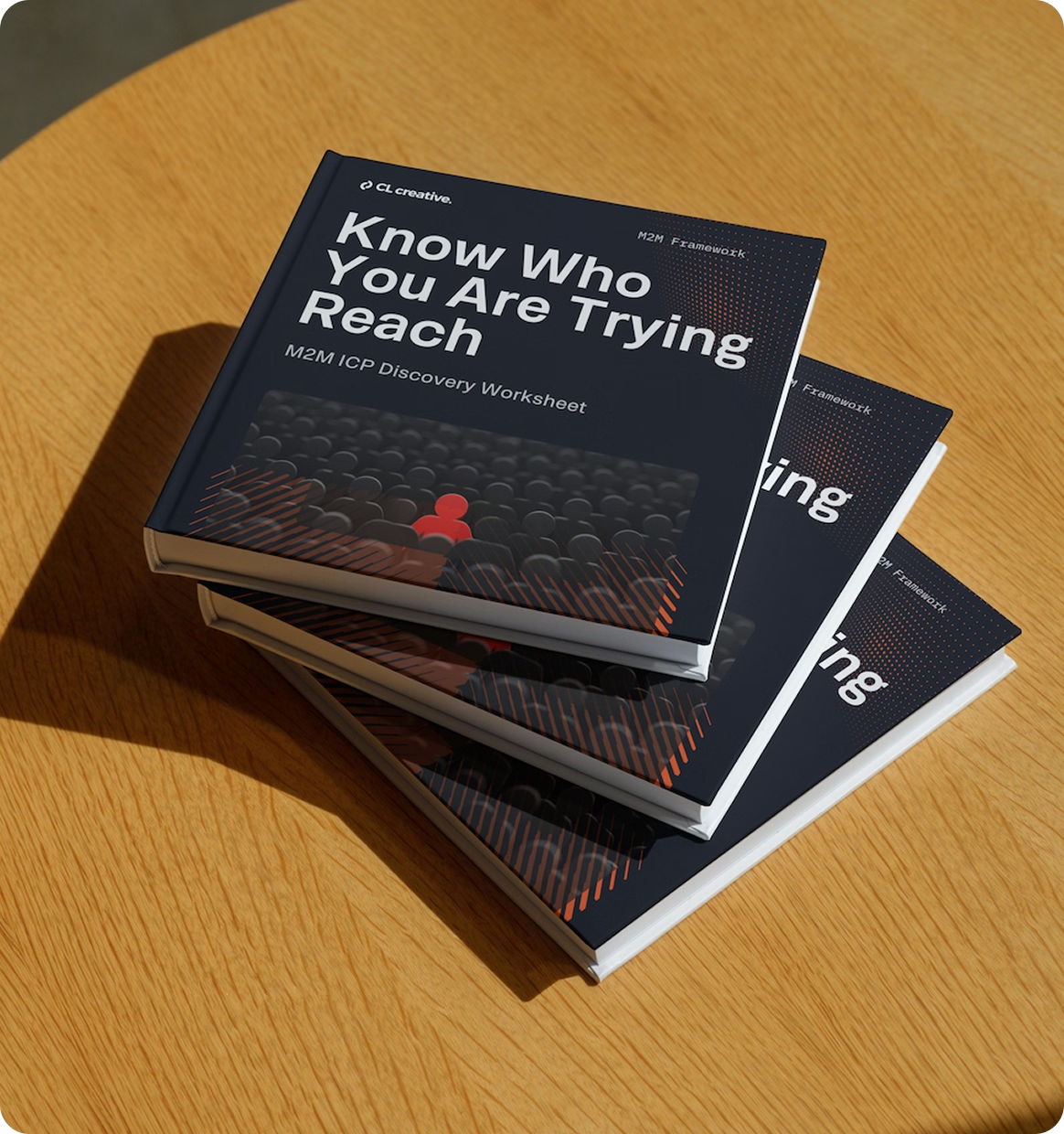
Get the M2M ICP Discovery Worksheet
Know who your website should speak to and what to say.
Your website gets visitors. It just doesn't get you leads.
You paid for a professional site a few years ago, and it looks the part. Clean layout, decent photos, your services listed neatly. And the contact form stays quiet for weeks at a time while your business runs on referrals and repeat work.
I've sat across from a lot of Dallas business owners at this exact point, and most of them assume the site needs a redesign. It usually doesn't. It needs something harder and cheaper: a message.
Why Your Dallas Website Isn't Generating Leads
The short answer: your website speaks to everyone, so it convinces no one. It describes your services instead of your customer's problem, in the same words every competitor uses. Visitors can't tell why you, so they keep looking. Design, speed, and SEO problems are real, but they're almost never the first problem.
Here's a test you can run tonight. Pull up your homepage and mentally swap your logo for your closest competitor's logo. Read it again. Does the page still work?
Think about that swap test like tasting someone else's iced tea. If you can't tell whose glass is whose, the tea isn't the point anymore. Price becomes the point. And competing on price in a market like Dallas is a race you don't want to win.
A generic site can't tell your best-fit customer they're in the right place. A generic site can't justify your price. A generic site can't get quoted by the AI tools your buyers now ask for recommendations. Generic loses three games at once.
The Numbers That Tell You It's the Message
A healthy service business website turns somewhere between 2% and 5% of visitors into inquiries . If you have real traffic and you're sitting under 1%, you don't have a traffic problem. You have a conversion problem, and conversion problems are almost always message problems.

And the stakes keep rising. 84% of consumers search for local businesses online daily, and 60% now click AI-generated overviews in Google before they ever see your site. Vague websites don't get summarized well, don't get cited, and don't get clicked. Specific ones do.
Notice the order of failure. The message fails first. Everything downstream of it, from your ads to your SEO to your referral follow-through, just inherits the failure.
The Redesign Trap
Here's where a lot of Dallas businesses lose a year and $15,000. The site underperforms, so they hire someone to make it prettier. New fonts, new photos, same vague promises. Traffic holds steady. Leads stay flat. We wrote a whole post on why the last redesign didn't fix the lead problem , and the pattern is nearly universal: the visuals changed, the message didn't.

I believe design is the amplifier, not the signal. Great design makes a clear message land harder. It makes a vague message look expensive.
Now, I don't think this means design doesn't matter. An outdated, slow, hard-to-use site absolutely costs you trust, and eventually you should fix it. It means order matters. Message first, design second. Get them backwards and you pay for the same site twice.
What Fixing It Actually Looks Like
This is the exact problem our M2M Framework exists to solve. M2M stands for Market to Message, and the order of the name is the whole point.

Step 1: Know your market
Get specific about who your best customer actually is. Not "Dallas homeowners" or "North Texas businesses." The specific person with the specific problem who pays you happily and refers you often. Talk to them. Write down the exact words they use to describe the problem, because that language becomes your copy .

Step 2: Refine your message
Say something your competitor can't copy word for word. Lead with your customer's problem in their language, name who you're for (and who you're not for), and back it with specifics: real numbers, real projects, real neighborhoods. "Serving the DFW metroplex with excellence" is wallpaper. "We answer Lakewood service calls in under two hours" is a reason to call. Here's how to write copy that speaks to your ideal customer .

Step 3: Build and grow
Now the website, and everything that compounds after it: SEO, AEO so AI tools can recommend you, and content that answers the questions your buyers actually ask. That's how a site becomes a lead engine instead of a brochure.

Want to know which step is your bottleneck? Book a free 30-minute strategy session. We'll walk through your site and your market together, and you'll leave knowing whether your problem is message, design, or visibility, and what fixing it would cost. That clarity is yours whether we work together or not. Book a strategy session →
The Dallas Advantage Nobody Uses
Here's what's genuinely encouraging. Almost nobody in your local market is doing this work. Dallas is full of businesses with fine-looking, interchangeable websites. The bar for specificity is low, which means the first company in a category to publish real answers, real pricing context, and a real point of view tends to take a lead that's hard to claw back. Local search rewards it. AI search rewards it faster. That's the core of how we approach web design for Dallas businesses.
Your website is either working for you or it's costing you. Which one is it doing right now?
Ready to fix the message before you pay for another redesign?
Book a free 30-minute strategy session. We'll look at your current site, your best customers, and where you're losing leads. You'll leave with a prioritized fix list and a rough budget range, whether you hire me or not. Book a strategy session →

Your Marketing Isn't Bringing in Leads and You Can't Figure Out Why
Score your marketing across 7 key areas in 5 minutes and find out exactly what's holding back your leads and what to fix first.
Questions You Might Be Asking
Traffic without leads almost always means a messaging problem: the site doesn't tell your best-fit visitor why you're the right choice, so they leave and keep searching. Check your conversion rate first. If you're under 1% with real traffic, the message is the bottleneck, not the marketing.
Run the logo swap test. If your homepage still works with a competitor's logo on it, the message is generic and that's your first fix. If the message is sharp but the site looks dated, loads slowly, or breaks on mobile, then design and build are the priority. Most sites we audit fail the swap test first.
Between 2% and 5% of visitors becoming inquiries is healthy for a service business site. Under 1% with steady traffic means the site is losing deals you never see. Local factors like reviews and Google Business Profile affect the number, but messaging drives the biggest swings.
Messaging first, almost every time. A redesign built on a vague message gives you a prettier version of the same lead problem, and you end up paying for the site twice. Lock in who you serve and what you say, then design and build around it. That's the exact order of our M2M Framework.
Conversion improvements show up fast, often within the first month, because you're converting traffic you already have. Visibility improvements from SEO and AI search compound more slowly, typically over three to twelve months. That's why we fix the message first: it pays back immediately and makes every later investment work harder.


