

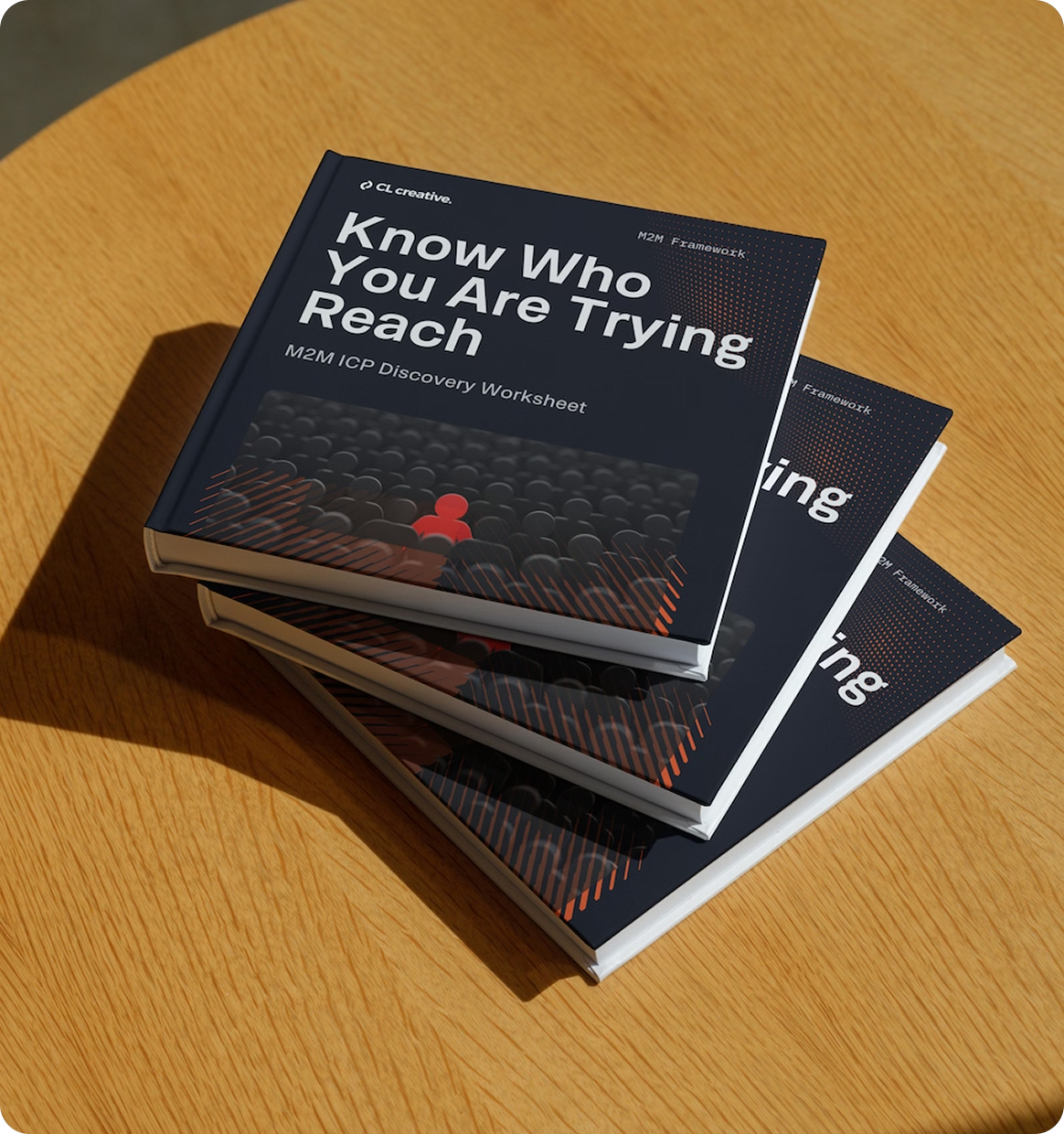
Get the M2M ICP Discovery Worksheet
Know who your website should speak to and what to say.
Most business owners think a high-converting website starts with design. Pick a template. Choose the colors. Argue about the logo. Launch it and wait for the leads to roll in.
Then nothing happens.
I believe the most important part of a website project isn't the homepage. It's the first conversation, the one about your goals, your customer, and what the site is supposed to do. Get that conversation right and conversion stops being luck. Skip it and you're decorating a guess.
The data backs this up. According to Unbounce's Conversion Benchmark Report, the median landing page converts at 6.6%. Top performers convert at 35% or more. That gap isn't a talent gap or a budget gap. It's a process gap.
Here's the process I use on every CL Creative project, in five steps: strategy, structure, copy, launch, and improvement. No guesswork, no fluff. Just a blueprint you can follow.
Why Designing First Fails
After years of building websites for business owners, I've watched the same story play out. A business owner hires a designer. The site launches and it looks great. Everyone celebrates. Then the business changes, the market shifts, and the site doesn't. Traffic shows up and bounces. Soon nobody sends prospects to the site at all, and the whole pipeline runs on referrals and hope.
The site was never the problem. The order of operations was. Design answers the question “how should this look?” Strategy answers the question “what should this do?” Answer the second question first and every design decision gets easier. Skip it and you get a beautiful site that misses the mark.
Now, I don't think this means design doesn't matter. It matters a lot. A dated site costs you trust before anyone reads a word. But design without strategy is a coat of paint on a house with no foundation.
Step 1: Start With Strategy, Not Design
Before you talk about colors or buttons, you need to talk about goals. Every project I run starts with four questions:
- Who's visiting the site?
- What do they need to see to trust you?
- What should they do next?
- What happens after they do it?
Those four answers shape everything else. They tell you which pages you need, what the homepage has to say, and what a “conversion” even means for your business.
This is the whole reason I built the M2M (Market to Message) Framework. You start with the customer you're trying to reach, develop messaging that speaks to them, then build the site around that message. Strategy, then design and development, then scale. In that order, every time.
The biggest mistake at this stage is skipping it. Discovery feels like a delay when you're excited to build, so businesses cut it to save time, make assumptions about what visitors want, and pay for those assumptions for the next three years. Business.com reports that 74% of visitors will leave a site that isn't mobile-friendly. That's one bad assumption (“everyone browses on a desktop”) doing expensive damage in the background.
Want to work through this step before you hire anyone?

Get the M2M Worksheet
The M2M Worksheet helps you define your ideal customer, so your positioning is sharp. It is the first step in developing messaging that resonates and converts.
Step 2: Build the Blueprint With Wireframes
A homepage is not a canvas. It's a map. Every section should move a visitor one step closer to the action you defined in Step 1.
Wireframes are how you draw the map before you pay for the trip. They're simple black-and-white layouts that strip away color, photography, and polish, which forces the decisions that actually determine conversion: what goes above the fold, where the calls to action sit, and what order the story unfolds in.
A few rules I hold to on every wireframe:
- Use real content, not lorem ipsum. Placeholder text hides structural problems until they're expensive to fix.
- Put the value proposition above the fold. A visitor should know what you do, who it's for, and what to do next without scrolling.
- Place trust signals where doubt shows up. Testimonials and proof belong next to the ask, not buried on an About page.
Wireframing feels slow. It's the opposite. Deciding on structure while structure is still cheap to change is what cuts revision cycles later.
Step 3: Write Copy That Converts
The design might pull them in, but the copy is what makes them stay.
Simple copy wins, and it's not close. Unbounce's research found that pages written at a 5th to 7th grade reading level convert at 11.1%, while college-level copy converts at 5.3%. Notice what that means. Writing simpler, not smarter, roughly doubles your results.
Your copy doesn't need to be clever. It doesn't need to be long. It doesn't need to win awards. It needs to tell the right customer they're in the right place, then show them what to do next.
The pattern I follow on every page:
- Start with the pain or the desire, in the customer's own words.
- Clarify the offer fast. No mystery.
- Remove doubt with specifics: numbers, names, proof.
- Make the action feel easy and worth taking.
And write your calls to action like promises, not buttons. “Submit” converts like a shrug. “Get the free audit” tells the reader exactly what they get. In Unbounce's published case studies, one company lifted conversions 304% just by making its CTA more specific.
Step 4: Launch With a Plan
Launch day isn't the finish line. It's the starting line.
Before the site goes live, three things have to be true:
- It's fast. Research from Invesp shows conversion rates drop about 4.42% for every extra second of load time in the first five seconds. Speed is a conversion feature, not a technical detail.
- Tracking works. If you can't see which pages and CTAs convert, Step 5 is impossible. Set up analytics and conversion tracking before launch, not after.
- The follow-up exists. A lead who fills out your form and hears nothing for three days is a lead you paid to lose. Have the email sequence and response process ready on day one. I use my CRM for this. Honeybook has built in automations that make it easy for me to send a follow up email after someone fills out my form. Most CRM's have this as well.
Then point traffic at the site on purpose. Email your list. Share it where your customers already are. Watch the first two weeks in real time, because early behavior shows you exactly where the friction is.
Step 5: Improve Based on Data
Great websites aren't lucky. They're built with intention, then made better with evidence.
Here's the rhythm I recommend:
- Collect data for the first two weeks
- Make your first adjustments in weeks three and four
- Then settle into a monthly review with a bigger iteration each quarter.
Small, steady changes compound.
And they compound fast. In those same Unbounce case studies, Bear Mattress lifted sales 24.18% through UX improvements, and Walmart Canada grew conversions 20% by rebuilding its mobile experience. Neither win came from a redesign. Both came from watching real behavior and responding to it.
Track a handful of numbers, not fifty. These are the six I pull for every landing page in my own monthly analytics report, and they're a great place to start:
- Sessions by landing page. Where visitors actually enter your site, not just how many showed up.
- Engaged sessions. The visits where someone actually stuck around instead of bouncing.
- Engagement rate. The percentage of sessions that were engaged, so you can compare pages fairly.
- Average engagement time per session. How long each page holds attention once someone lands.
- Key events. The conversions you defined in Step 1, like form fills and booked calls.
- Session key event rate. The percentage of sessions that convert. This is your conversion rate, page by page.
When one of them moves, you'll know where to look.
Most Businesses Don't Need More Traffic
They need a site that converts the traffic they already have.
That's the whole blueprint.
- Strategy before design.
- Structure before polish.
- Copy that sounds like your customer.
- A launch with a plan.
- Improvement based on evidence instead of opinions.
Your website is either working for you or it's costing you. Which one is it doing right now?
Start with the first conversation.
Get the M2M Worksheet. It's the same market-to-message framework I use on every CL Creative project: define your customer, sharpen your message, and map what your site needs to do before you spend a dollar on design. It's free, and it works whether you build with me or with someone else.
Get the M2M Worksheet
The M2M Worksheet helps you define your ideal customer, so your positioning is sharp. It is the first step in developing messaging that resonates and converts.
Already past the worksheet stage? Book a 30-minute strategy session.

Want a website built on a system, not guesswork?
Send me a message and tell me about your project. I'll come back with a clear picture of what your site needs to do and a rough budget range, whether you hire me or not.
Questions You Might Be Asking
For most growth-stage businesses, plan on 8 to 12 weeks from first conversation to launch. Strategy and wireframing take up the first third of that timeline, and that's on purpose. The time spent before design is what makes the site convert after launch.
Knowing your customers and having documented messaging for them are two different things. Every business owner I've worked with knew their customer; almost none had written down the words that customer uses to describe their problem. The strategy step turns what's in your head into decisions a designer and copywriter can actually build from.
The median across industries sits around 6.6%, so anything above that puts you ahead of most sites. Focused landing pages from top performers reach 35% or more. The more useful benchmark is your own trend line: if your rate climbs month over month, the process is working.
Yes, and smaller sites need them more, not less. With only five or six pages, every section has to earn its place, and wireframes force those decisions while changes are still cheap. An afternoon of wireframing routinely saves weeks of design revisions.
A template can be the right call if you're pre-revenue and just need to exist online. Once your business has real revenue, the math changes: a site converting at 2% instead of 6% costs you customers every single month, and that gap usually dwarfs the cost of building it right. You're not paying for pages. You're paying for the process that makes the pages convert.


